The Children of William and Lydia Coleman Mitchell
Jascin N. Leonardo Finger • September 23, 2024

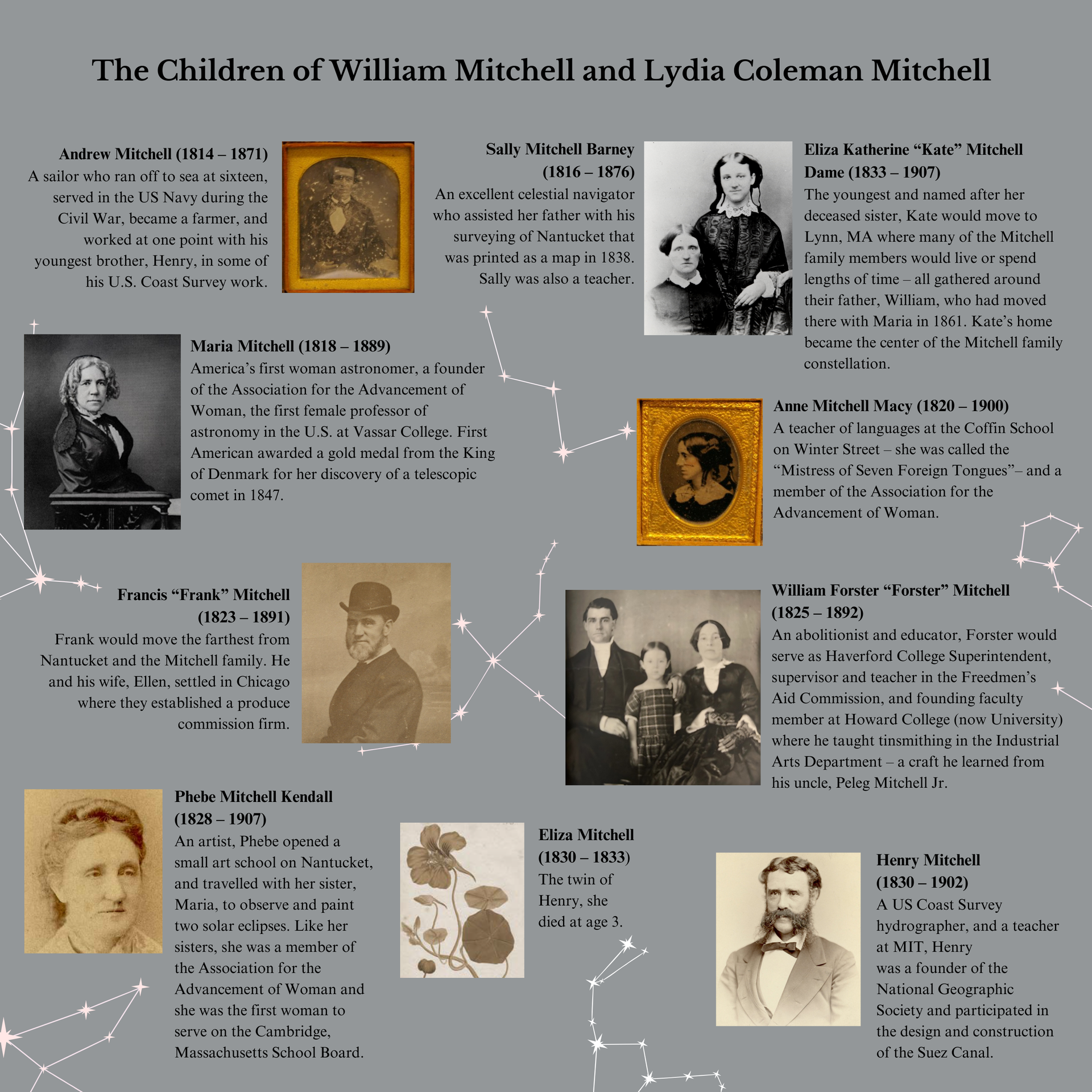
From time to time, I have mentioned, most if not all, of the children of William Mitchell and Lydia Coleman Mitchell. However, I have not listed them and their accomplishments all together. While brief, I thought this would be nice to help highlight Maria Mitchell’s siblings.


Andrew Mitchell (1814 – 1871) A sailor who ran off to sea at sixteen, served in the US Navy during the Civil War, became a farmer, and worked at one point with his youngest brother, Henry, in some of his U.S. Coast Survey work.


Sally Mitchell Barney (1816 – 1876) An excellent celestial navigator who assisted her father with his surveying of Nantucket that was printed as a map in 1838. Sally was also a teacher.


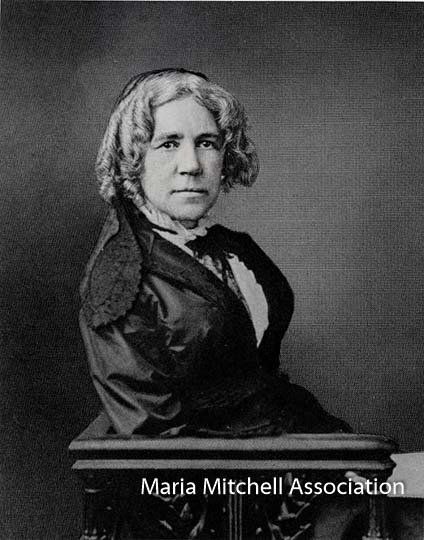
Maria Mitchell (1818 – 1889) America’s first woman astronomer, a founder of the Association for the Advancement of Woman, the first female professor of astronomy in the U.S. at Vassar College. First American awarded a gold medal from the King of Denmark for her discovery of a telescopic comet in 1847.


Anne Mitchell Macy (1820 – 1900) A teacher of languages at the Coffin School on Winter Street – she was called the “Mistress of Seven Foreign Tongues” – and a member of the Association for the Advancement of Woman.


Francis “Frank” Mitchell (1823 – 1891) Frank would move the farthest from Nantucket and his family. He and his wife, Ellen, settled in Chicago where they established a produce commission firm.


William Forster “Forster” Mitchell (1825 – 1892) An abolitionist and educator, Forster would serve as Haverford College Superintendent, supervisor and teacher in the Freedmen’s Aid Commission, and founding faculty member at Howard College (now University) where he taught tinsmithing in the Industrial Arts Department – a craft he learned from his uncle, Peleg Mitchell Jr.


Phebe Mitchell Kendall (1828 – 1907) An artist, Phebe opened a small art school on Nantucket, and travelled with her sister, Maria, to observe and paint two solar eclipses. Like her sisters, she was a member of the Association for the Advancement of Woman and she was the first woman to serve on the Cambridge, MA School Board.


Eliza Mitchell (1830 – 1833) The twin of Henry, she died at age 3.


Henry Mitchell (1830 – 1902) A US Coast Survey hydrographer, and a teacher at MIT, Henry was a founder of the National Geographic Society and participated in the design and construction of the Suez Canal.


Eliza Katherine “Kate” Mitchell Dame (1833 – 1907) The youngest and named after her deceased sister, Kate would move to Lynn, MA where many of the Mitchell family members would live or spend lengths of time – all gathered around their father, William, who had moved there with Maria in 1861. Kate’s home became the center of the Mitchell family constellation.


JNLF

Recent Posts
By Jascin N. Leonardo Finger March 23, 2026
March is Women’s History Month – though all months should be women’s history month! Maria Mitchell was one of the founders of the Association for the Advancement of Women (AAW), was its president for a term (1875), and founded its Science Committee which she chaired for the remainder of her life. When the fourth Congress of the AAW met in Philadelphia in October 1876, Julia Ward Howe (also a friend of Maria’s) was serving with Maria on the executive committee. Maria presented a paper, “The Need for Women in Science.” In it she stated, Does anyone suppose that any woman in all the ages has had a fair chance to show what she could do in science? . . . The laws of nature are not discovered by accidents; theories do not come by chance, even to the greatest minds; they are not born of the hurry and worry of daily toil; they are diligently sought, they are patiently waited for, they are received with cautious reserve, they are accepted with reverence and awe. And until able women have given their lives to investigation, it is idle to discuss the question of their capacity for original work. She is not saying that women cannot be scientists – she is saying they need to be given the opportunities. Maria was incredibly busy with the AAW – it took up a great deal of her time – and at the next meeting in November of that year some aspects of the meeting were wonderful according to her account –“excellent” papers, “newspapers treated us very well. The institutions opened their doors to us, the Centennial gave us a reception. But – we didn’t have a good time!” It appears there was discord among the women. A few opposed the subject of “Woman Suffrage,” but Lucy Stone was able to present her paper on the subject despite this. And, some women felt that the West was not well represented and was overshadowed by New England, thus women representing the western states protested the nomination and election of Julia Ward Howe as president of the AAW. But she won. Whew! It was not always easy and controversies constantly abounded with many schisms over time within the women’s rights movement. I often wonder what Maria might think of the place of women today – how far things have come from her time or would she be surprised that there still is inequality? What would she think? In honor of Women’s History Month, visit the National Women’s History Alliance, the National Women’s History Museum, and the National Collaborative of Women’s History Sites. These places will also point you in the directions of women’s history sites across the country and how to find out more information about all these women who paved the way for us!  JNLF
By Jascin N. Leonardo Finger March 17, 2026
For several years now, we have been teaming up with the Nantucket Historical Association in March for Women’s History Month. We visit each senior living or meeting site on island – five in all over the course of the month. We work to unique history of the place of women in our community then and through today – an incredible legacy that in the nineteenth century and earlier was quite unusual. We highlight women from all walks of island life, their accomplishments, and how they helped and influenced others. You see, Maria Mitchell was not the only incredible woman that Nantucket produced. For example, Eliza Codd was the island's first woman architect - and the leading architect on island when she practiced. Nantucket women shared their knowledge, path, support, and guidance with others both here and away and became major influences in the rights of women, women’s education, and the general place of women in society. Pretty incredible for such a small island! JNLF
By Jascin N. Leonardo Finger March 9, 2026
I have posted this during Women’s History Month before but because it is March and again Women’s History Month, I think it’s worth repeating. It’s clever and helps to tell an important story in women’s history while giving it a bit of a 21 st century twist. It comes via the National Women’s History Project. JNLF
Show More