
Stone Monument Cleaning

Jascin N. Leonardo Finger • October 27, 2025

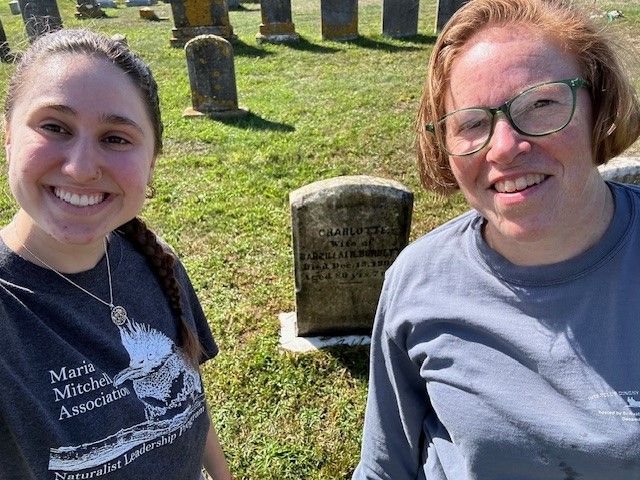
I have discussed the process and importance of the proper cleaning and conservation of historic stone monuments – cemetery stones – several times before in this blog. This year’s Mitchell House intern, Talia, was also (happily) last year’s intern and due to her college graduation in early June, she missed the annual workshop I have been running concerning the proper care and cleaning of stone monuments. A stone monument enthusiast, I promised Talia we would clean a stone before she left this season. Happily, we did on September 26. We returned together to clean the stone of Charlotte Burdett, Captain of Barzillai Burdett, one of my favorites. I had come across his stone accidentally when prepping to clean another stone for the workshop in June. (I test stones about a month before I clean them to make sure the cleaner will be okay and there are not any issues with it among other things I check for.) I tested the two Burdett stones and after the workshop was over, I remained in the now fairly hard rain showers to clean his stone. At that point, I was sopping wet and I told Charlotte I would return.  I always feel badly when I have to return months, or a year, later to complete the stones in a lot. 

We made fast work of Charlotte’s stone – a little under an hour but the Burdetts’ stones are relatively small and simple. It was also a beautiful day to complete the work.


The remainder of this blog will be a bit long because I wanted to share some information on Captain Burdett. He and Charlotte had no children and I have long loved their simple, small gambrel house on North Liberty (not likely a gambrel when they inhabited it). So here we go.


In the history of catboats on the island, the Dauntless is my favorite catboat, likely because the owner/captain is a Nantucket “rockstar” of mine. His small gambrel roofed house still stands along North Liberty – a favorite house of mine before I learned a “rock star” inhabited it! The Dauntless was sometimes referred to as the “star boat” because a large red star was sewn on her sail. Built and captained by boatbuilder, Captain Barzillai Burdett, the Dauntless took visitors from the wharves out to the bathing beaches and on clambakes and fishing excursions, beginning in the early 1870s.  Two logs of the Dauntless attest to her being a busy boat, enjoyed not only by the passengers, but by her crew as well. The logs live at the Research Library at the Nantucket Historical Association (NHA). At least one was kept by Benjamin Sharp. When he was young, he served aboard the Dauntless with Captain Burdett. Sharp would become a revered island resident. Born in 1858, Dr. Sharp, a zoologist, was a founder of the Nantucket Cottage Hospital, served as Nantucket’s representative in the state legislature, and was an avid sailor and fisherman. In 1904, with Henry W. Fowler, he wrote The Fishes of Nantucket


Times spent with Captain Burdett must have greatly influenced Sharp. One of the logs dates from July 2 through August 28, 1873, and is a daily record of fishing parties and clambakes the Dauntless provided. The log also includes the names of passengers and where they came from, as well as messages they left for Captain Burdett. Included in the log is this poem:


When you go to a clambake,

Plenty of chickens you should take,

As then you have a second dish

For those who do not like shell-fish,

For all should indulge, as best they might,

“The keen demands of appetite.”


The log also has lots of wonderful, comical illustrations − largely drawn by Sharp. 


Burdett also built whaleboats during the heyday of whaling on the island. Fishing was also his economic mainstay. When summer was over, he would use the Dauntless to fish as many other catboat owners did. The tourist trade had come second to fishing and whaling on the island but, in many cases, may have made fishing secondary in income once tourism took off on island and became much more lucrative.  In 1893, artist Elizabeth Rebecca Coffin (a distant cousin of Maria Mitchell’s and one of her students at Vassar), painted a lovely double portrait of Burdett and Benjamin Pease in Burdett’s shack on Old North Wharf called “A Tale of the Sea (Captain Burdett In His Boathouse).”  Today, it is in the collection of the NHA.


PLEASE NOTE: ONE SHOULD NEVER CLEAN THE STONES IN A CEMETERY, WHETHER THEY ARE YOUR FAMILY’S OR NOT, WITHOUT PERMISSION FROM THE CEMETERY SEXTANT AND HAVING BEEN TRAINED TO PROPERLY CLEAN A STONE. There are quite a few TikToks and other social media posts and people are doing the work incorrectly and damaging and further eroding the stones.


JNLF

Recent Posts
By Jascin N. Leonardo Finger May 18, 2026
A repost from long ago – because I still like a good chair. Quite awhile ago, I wrote about some of my collection addictions, including pottery shards, 19 th century kitchen mirrors, and of course, enamelware. Well, here is another one for you. I love chairs. Yes, this is another collection addiction of mine. But not all chairs – chairs from the eighteenth and nineteenth centuries. Typically, I like plain, simple wood chairs with a horizontal piece or two of wood for the back and a plain, thick wood seat. Simple, not a lot of turns to the wood, and not a lot of decorative features or paint. Several years ago, I had a meeting at the home of the leader of a group I was working with. She owned the Obed Macy house, very much untouched and quite a remarkable house. Yes, Obed was the Nantucket historian (among other things), as well as the son of island entrepreneur Judith Macy, and the nephew of the island “she-pirate” Kezia Coffin. We met outside on the side porch which was a late 19 th century addition to the house and one that certainly reflected what life was like in the period it was added to the house. The owner had brought out every chair in her home. I was on a chair high (not a highchair!) – here I had my choice of nineteenth chairs to sit on. Since I was one of the first to arrive, I took my time picking out which chair I was going to sit on – I kid you not. I was like Goldilocks − though I was grown-up enough not to sit on every chair to decide which one I was going to claim for the meeting! I went on and on and likely on and on about all these lovely chairs to her. Unfortunately, the day came several years later when she was faced with having to sell her beloved home to move off-island. She called me. She wanted to know if I wanted any of her chairs since she remembered how much I went on and on about them. It was a mixture of emotion because losing this island resident was a loss for the island and for its history and historic architecture. I went to her home a few days before she was going to have her sale and helped her move items from the house out onto the lovely 19 th century side porch where I first reveled in her chair collection and also out into the large, simple backyard that looked like it too had not been touched since the 19 th century. She told me to take whichever chairs I wanted as she wanted me to have them. Depressing. I told her I would not take but that I would buy. We had a little back and forth but she finally relented. Then, I had to choose and it was quite agonizing. Not wanting to be a chair hog, I limited myself. I now have two matching and two others sitting around my dining room table made from salvaged Nantucket pine floorboards. We refer to them as “Helen’s chairs” – their previous owner. She likely found them here on Nantucket; one or more may have even come with the house when she bought it. We eat every meal sitting in them, spend time with our family in long discussions and laughter sitting in them, and each time I sit, touch, dust, or move them, I think of Helen and the house these chairs once sat in and the conversations and people they must have witnessed over the many years. A simple wood chair – a witness to history and time. JNLF
By Jascin N. Leonardo Finger May 11, 2026
A repost – with my apologies – from last year. It started budding the week of April 30 this year. This is what our landscaper for the MMA calls it. “The ancient vine.” He tells the people who work for him not to touch the “ancient vine.” I have probably made him – and all of them – terrified of it. I am even terrified of it to some degree. I refer to the grape vine behind the Mitchell House that is supposed to be Peleg Mitchell Junior’s grape vine – Maria Mitchell’s uncle who inhabited the house from about 1836 to his death in 1882. It has two trunks but one died several years ago. Because of that, each year I try to root shoots. It’s fairly easy to do – when you cut back the vine in late fall/early winter. I have had success but not success protecting the shoots I baby all winter from bunnies and other critters once I plant them – try as I might. I started doing this when the one trunk died – I was PANICKED! The landscaper stays away because I have told him if anyone is going to accidentally harm or worse yet, kill, this grape vine it would be me so I only have myself to blame. So each November/December – once ALL the leaves have fallen off – I climb my ladder and quietly, carefully, and fearfully cut back the stems typically to two buds. I have been somewhat successful in spurring grape production – and these grapes attract some amazing birds in the fall. It takes me some time – and I pretty much hyperventilate the entire time – and then, I stare at it all winter. Passing under it multiple times a day to reach my office. Hoping, and yes, praying, it will come out in the spring. It’s a late budder so just recently the buds started to show themselves – thank goodness! – and I was rewarded today (May 5, 2025) with this wonderful hot pink color on the edges of the leaves as they are uncurling. JNLF
By Jascin N. Leonardo Finger May 4, 2026
May 6, 1878 Between the clouds, Miss Spalding obtained 7 photographs of Mercury on the Sun. It is comfort to me to be able to plan and do a new kind of work. The large telescope worked better than usual, Clark having just been to the Observatory. Clark, as in Alvan Clark, a man who would become the premier telescope maker in America and who built Maria Mitchell’s 5-inch Alvan Clark refractor that she purchased from him (after working with him to build it per her specifications) with money gifted to her from “The Women of America” led by Elizabeth Peabody. More than likely, it is this telescope she is referring to as she did use it in the Vassar College Observatory with her students – and it is also taking center stage in photographs, along with her (first her father’s) Dolland telescope.  Maria had decided she would photograph the Sun on every clear day, and this was one of those results. She would use these images, with her students, to study sun spots and their changes. With her students, Maria would photograph the transit of Mercury as noted above. She would also photograph the transit of Venus a few years later with her students. JNLF
Show More