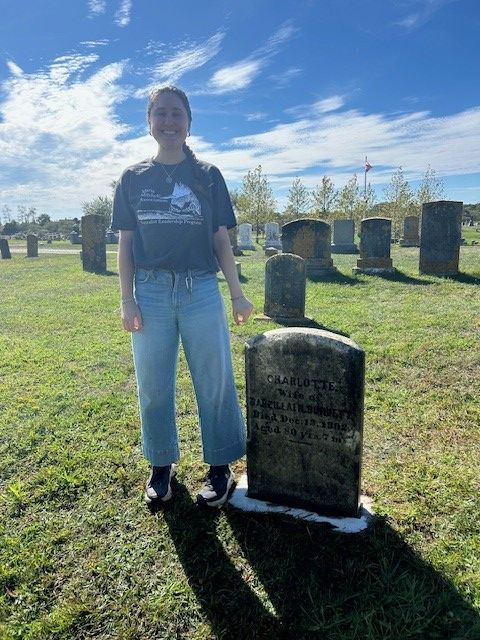

A Walk Among the Dead

Jascin N. Leonardo Finger • June 8, 2026

I love to walk in the cemetery. The stones are quite beautiful, as is the landscape. Is it sad? Yes, but its not creepy or scary. Many of these people have been forgotten. Though at the time of their death, their family did not think they would be – nor perhaps did those people before they died. I find it sad to come across fallen or broken stones, stones that have been overgrown with weeds or a well-intended shrub that has now taken over the space after 100 years or so.  Stones covered so heavily in lichens that you cannot read the name of the person buried there invokes sadness and is worrisome for the damage the lichen can do. The young children, infants, teenagers, and young adults – that is all the more painful – as they were short-changed on life. But the old people – those who lived a full and very long life – they got all the time. And while it’s sad, they are gone, their life was full – no cut off at an early age.


I have written about cemeteries before. I have noted that I clean stone monuments (gravestones) and run a workshop once a year to teach people how to properly clean stones. There is a bit of a movement afoot – especially with Instagram and TikTok – where people record themselves cleaning stones and showing people how to do it. Please be careful – some people are not trained and are doing it the wrong way. The sound of a metal scraper sets my teeth on edge – that is NOT how you clean historic gravestones – THAT erodes the stone and damages it forever. So, until you have some in-person training by someone who is qualified, do not do it! 


JNLF


This year’s stone cleaning workshop will be Saturday, June 13 from 10-Noon. Registration is necessary and there is a small fee – it covers the cost of the supplies.

Recent Posts
September 1, 2026
“If you don’t look, you don’t see. You have to go and look.” -Edith Andrews
By Jascin Leonardo Finger August 31, 2026
I’m sure you’ve seen it as you trek about the island – near the beaches and ponds. This image is of the swamp or marsh mallow that we have on Vestal Street in our garden out front of the Observatory. It can grow in drier places – though it’s not as lush as at Capaum Pond or out in Quaise. It’s in the Hibiscus family – and is fairly tropical looking and always a delight to see.  “When in bloom, one of the most showy plants of the Island, for a mass of the magnificent, large flowers on the edge of a blue pond causes one’s heart to thrill at the wealth of deep pink colour . . .” from Nantucket Wild Flowers, Alice O. Albertson (cousin of Maria Mitchell), 1921. JNLF
By Jascin N. Leonardo Finger August 24, 2026
I have always wanted to find a piece of a clay pipe. I know – weird – but if you have ever read any of my blogs here for the MMA then you know I have a thing for pottery shards. I sort of figured I would not find a piece of a clay pipe – not even a piece of a stem. But the other day, walking in a place where I have found quite a few shards, I found a piece of clay pipe! Now, I’m not talking about water pipes – I am talking about tobacco pipes. And I know very little about clay pipes. Yes, I am a curator of a historic house museum, but this family did not smoke. They were Quaker and among the many things they abstained from, tobacco was one of them. Therefore, I am not up on clay pipes so I am doing a bit more research.  For one, age can be determined by the width of the hole inside the pipe. So based on this one, I would say it’s fairly late. Since they were so fragile, and those holes pretty small, if it got filled with tobacco, the person just broke off the stem creating a shorter pipe and one that was not clogged with tobacco. Apparently, stems could be recycled – in fact, 15,000 broken stem pieces were uncovered at a historic walkway at Colonial Williamsburg – they were used as fill! And pipes were made into the early twentieth century – falling out of favor around World War One. It makes sense – they were cheap, easy to make, and affordable. Typically, one could last a few years – unless you dropped it of course. An,d pipes were used by men, women, and (eh, em) yes, children. I can see that Nantucket may not have had a lot of tobacco smoking residents – not just that some were Quaker – but because of the Quaker influence. I t does not mean people here do not smoke – I just think there may have been fewer smokers on the island in the nineteenth century and earlier. JNLF
Show More