
Masonry Conservation Accomplished!

Jascin N. Leonardo Finger • April 10, 2023

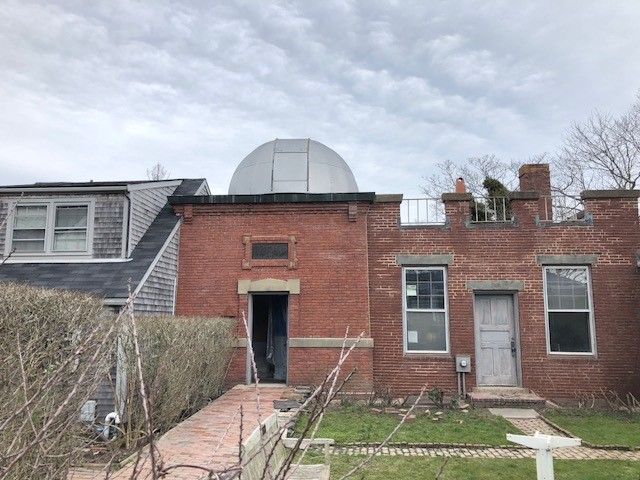
With the COVID-19 Pandemic severely slowing the start of the conservation project and supply chain issues, as well as weather, among other things, it has been a long road but we have finally completed the masonry conservation and roof repairs at our historic Maria Mitchell Vestal Street Observatory!


I say “we” but this was the fantastic work of island mason, Wayne Morris. He has accomplished a great deal and the building is now weather tight, brick and grout are secure, and we have new steel lintels over doors and windows. It sounds simple doesn’t it? But, it is not and it has taken a lot of time and care – and all sort of new and interesting issues were revealed as old repairs were removed and things were opened up – things you cannot see until you dig. Even removing one lintel is a painstaking process – especially on the main floor where you have large stone pieces over each opening that “hide” the original iron (and rusting) lintel beneath. It’s not everyone who can do a project such as this and the MMA is lucky to have had Wayne Morris. He’s talented, knows how to think outside the box, and genuinely knows and loves what he does. He spent a lot of hours grinding up stone to match the 1908 and 1922 grouts and trying to match the color. Not many will take that time and its important that we do for conservation reasons. I’ve learned some things from him over the years – including to call it “grout.”


I would also like to thank James Lydon and Sons and Daughters for the work to the rubber and copper on the two roofs, and to Jeff Schneider and Ellis and Schneider Electrical for moving the electrical lines so that the mason could get to one of the lintels in the basement. Apparently, at some point, long ago, they thought it was a good idea to run conduit pipe for electrical wires in FRONT of a cellar window thus negating the possibility of it being opened AND blocking the lintel that Wayne Morris needed to replace!


We still have to clean up the landscape, put in a French drain in front, and paint the windows and wood door – and remove the paint from the original 1908 copper door. Then, the exterior will be complete. Next up, conservation of the interior which will include conservation of the original 1922 Astronomical Study’s floor and woodwork, painting, the addition of new wood storms on the façade, HVAC, and electrical upgrades. So, there is more to come – but first we needed to be weather tight!


JNLF


P.S. Not sure what I am going to do. I’ve worked on several projects here at MMA and at the Coffin School with Wayne Morris. I keep teasing him we can’t let him go. Going to miss seeing his truck parked in our front yard at MMA – a parking spot only he could have!

Recent Posts
By Jascin N. Leonardo Finger May 18, 2026
A repost from long ago – because I still like a good chair. Quite awhile ago, I wrote about some of my collection addictions, including pottery shards, 19 th century kitchen mirrors, and of course, enamelware. Well, here is another one for you. I love chairs. Yes, this is another collection addiction of mine. But not all chairs – chairs from the eighteenth and nineteenth centuries. Typically, I like plain, simple wood chairs with a horizontal piece or two of wood for the back and a plain, thick wood seat. Simple, not a lot of turns to the wood, and not a lot of decorative features or paint. Several years ago, I had a meeting at the home of the leader of a group I was working with. She owned the Obed Macy house, very much untouched and quite a remarkable house. Yes, Obed was the Nantucket historian (among other things), as well as the son of island entrepreneur Judith Macy, and the nephew of the island “she-pirate” Kezia Coffin. We met outside on the side porch which was a late 19 th century addition to the house and one that certainly reflected what life was like in the period it was added to the house. The owner had brought out every chair in her home. I was on a chair high (not a highchair!) – here I had my choice of nineteenth chairs to sit on. Since I was one of the first to arrive, I took my time picking out which chair I was going to sit on – I kid you not. I was like Goldilocks − though I was grown-up enough not to sit on every chair to decide which one I was going to claim for the meeting! I went on and on and likely on and on about all these lovely chairs to her. Unfortunately, the day came several years later when she was faced with having to sell her beloved home to move off-island. She called me. She wanted to know if I wanted any of her chairs since she remembered how much I went on and on about them. It was a mixture of emotion because losing this island resident was a loss for the island and for its history and historic architecture. I went to her home a few days before she was going to have her sale and helped her move items from the house out onto the lovely 19 th century side porch where I first reveled in her chair collection and also out into the large, simple backyard that looked like it too had not been touched since the 19 th century. She told me to take whichever chairs I wanted as she wanted me to have them. Depressing. I told her I would not take but that I would buy. We had a little back and forth but she finally relented. Then, I had to choose and it was quite agonizing. Not wanting to be a chair hog, I limited myself. I now have two matching and two others sitting around my dining room table made from salvaged Nantucket pine floorboards. We refer to them as “Helen’s chairs” – their previous owner. She likely found them here on Nantucket; one or more may have even come with the house when she bought it. We eat every meal sitting in them, spend time with our family in long discussions and laughter sitting in them, and each time I sit, touch, dust, or move them, I think of Helen and the house these chairs once sat in and the conversations and people they must have witnessed over the many years. A simple wood chair – a witness to history and time. JNLF
By Jascin N. Leonardo Finger May 11, 2026
A repost – with my apologies – from last year. It started budding the week of April 30 this year. This is what our landscaper for the MMA calls it. “The ancient vine.” He tells the people who work for him not to touch the “ancient vine.” I have probably made him – and all of them – terrified of it. I am even terrified of it to some degree. I refer to the grape vine behind the Mitchell House that is supposed to be Peleg Mitchell Junior’s grape vine – Maria Mitchell’s uncle who inhabited the house from about 1836 to his death in 1882. It has two trunks but one died several years ago. Because of that, each year I try to root shoots. It’s fairly easy to do – when you cut back the vine in late fall/early winter. I have had success but not success protecting the shoots I baby all winter from bunnies and other critters once I plant them – try as I might. I started doing this when the one trunk died – I was PANICKED! The landscaper stays away because I have told him if anyone is going to accidentally harm or worse yet, kill, this grape vine it would be me so I only have myself to blame. So each November/December – once ALL the leaves have fallen off – I climb my ladder and quietly, carefully, and fearfully cut back the stems typically to two buds. I have been somewhat successful in spurring grape production – and these grapes attract some amazing birds in the fall. It takes me some time – and I pretty much hyperventilate the entire time – and then, I stare at it all winter. Passing under it multiple times a day to reach my office. Hoping, and yes, praying, it will come out in the spring. It’s a late budder so just recently the buds started to show themselves – thank goodness! – and I was rewarded today (May 5, 2025) with this wonderful hot pink color on the edges of the leaves as they are uncurling. JNLF
By Jascin N. Leonardo Finger May 4, 2026
May 6, 1878 Between the clouds, Miss Spalding obtained 7 photographs of Mercury on the Sun. It is comfort to me to be able to plan and do a new kind of work. The large telescope worked better than usual, Clark having just been to the Observatory. Clark, as in Alvan Clark, a man who would become the premier telescope maker in America and who built Maria Mitchell’s 5-inch Alvan Clark refractor that she purchased from him (after working with him to build it per her specifications) with money gifted to her from “The Women of America” led by Elizabeth Peabody. More than likely, it is this telescope she is referring to as she did use it in the Vassar College Observatory with her students – and it is also taking center stage in photographs, along with her (first her father’s) Dolland telescope.  Maria had decided she would photograph the Sun on every clear day, and this was one of those results. She would use these images, with her students, to study sun spots and their changes. With her students, Maria would photograph the transit of Mercury as noted above. She would also photograph the transit of Venus a few years later with her students. JNLF
Show More