
Keep Calm and Bird On: June 2026

June 1, 2026
“If you don’t look, you don’t see. You have to go and look.”
-Edith Andrews
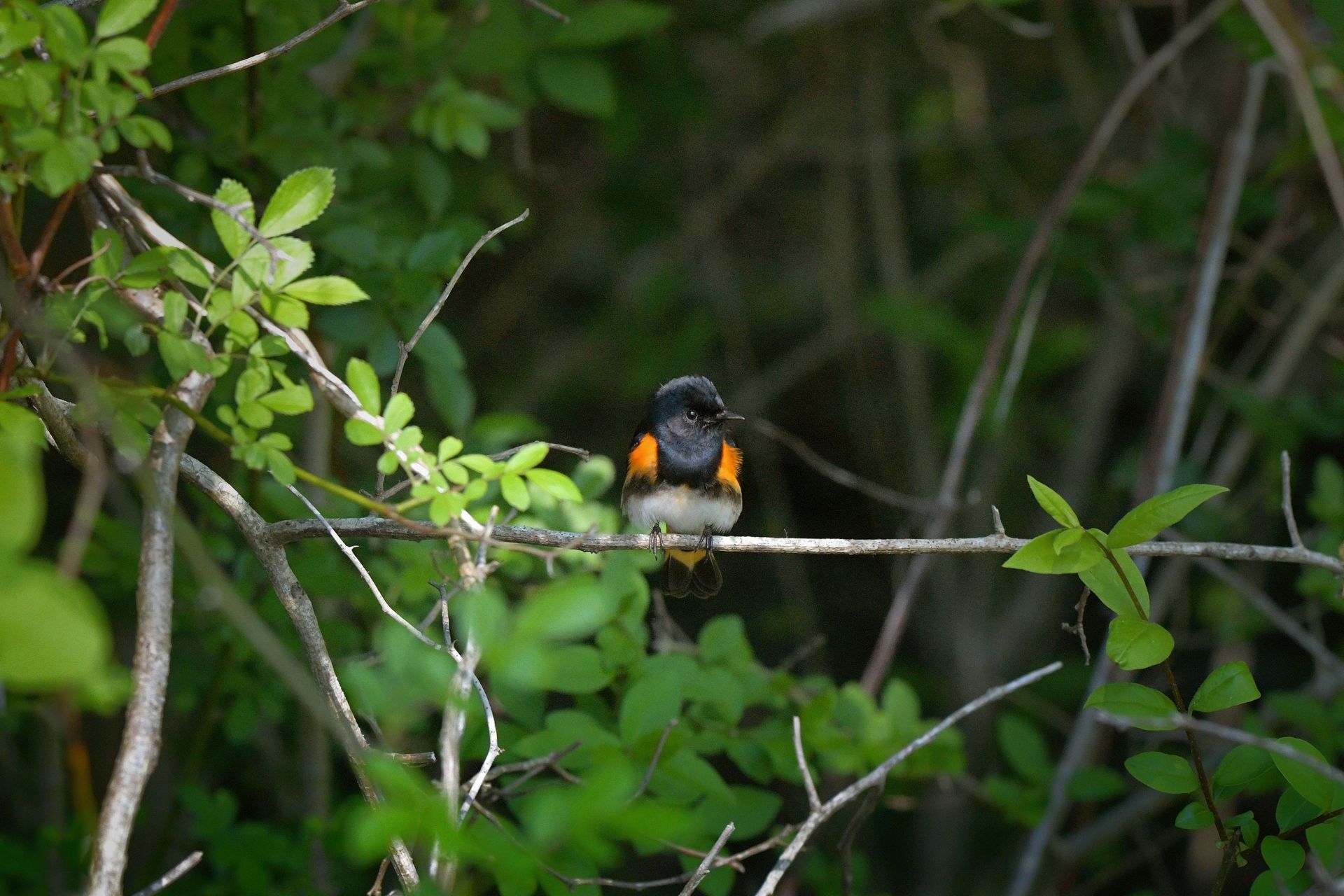
 Despite their flashy tails, American Redstarts are one of our more obscure Warblers breeding on Nantucket. But they have a reliable habitat in the trees near the Trustees parking lot in Wauwinet.

American Redstarts are one of six warblers reliably breeding on Nantucket. They have consistently nested in Wauwinet over many years, so it’s fun to see if they are back. This year a few were spotted early in other places, such as Madaket, Windswept Bog, or Town.


Common Yellowthroat, Pine, Prairie, Black-and-white, and Northern Yellow warblers are also consistent summer residents, raising their families here for a few months every year. Occasionally an Ovenbird or Northern Parula has remained all summer too. As migrants headed out for climes further north have mostly moved on, it’s time to concentrate on our summer breeding birds.


Many birds return to places where they hatched, or were successful at reproducing the previous year. But some may have hacked out new territory last fall, when birds of the year, wandering in every direction before heading south, explore new territory.


Males usually arrive first in the Spring, claim a spot, and sing to “record the deed” as it were, to their property. Every morning they announce that they have survived another night and are still in possession. But behavior is what tells us what’s going on.


Do you see a bird carrying nesting material such as vines, rootlets, feathers, grass, twigs, hair, or mud? Do you see multiple trips? Is a bird carrying visible food such as caterpillars, butterflies, dragonflies, or moths? Do you see squabbles, courtship flights, fluttering wings of begging females or young? Do you hear a chorus of begging noises whenever a parent disappears into a bush?


Simply sitting still in a quiet spot is a good way to see birds. A car makes a good mobile observation blind. The best time is very early in the morning, when it’s quiet, and raptors—and people—are not as active. It is a truly magical time of day. Birds also get busy again the last hour or so before sunset, but there’s often more human disturbance. Get up early; it’s worth it.

Recent Posts

By Jascin Leonardo Finger August 31, 2026
I’m sure you’ve seen it as you trek about the island – near the beaches and ponds. This image is of the swamp or marsh mallow that we have on Vestal Street in our garden out front of the Observatory. It can grow in drier places – though it’s not as lush as at Capaum Pond or out in Quaise. It’s in the Hibiscus family – and is fairly tropical looking and always a delight to see.  “When in bloom, one of the most showy plants of the Island, for a mass of the magnificent, large flowers on the edge of a blue pond causes one’s heart to thrill at the wealth of deep pink colour . . .” from Nantucket Wild Flowers, Alice O. Albertson (cousin of Maria Mitchell), 1921. JNLF
By Jascin N. Leonardo Finger August 24, 2026
I have always wanted to find a piece of a clay pipe. I know – weird – but if you have ever read any of my blogs here for the MMA then you know I have a thing for pottery shards. I sort of figured I would not find a piece of a clay pipe – not even a piece of a stem. But the other day, walking in a place where I have found quite a few shards, I found a piece of clay pipe! Now, I’m not talking about water pipes – I am talking about tobacco pipes. And I know very little about clay pipes. Yes, I am a curator of a historic house museum, but this family did not smoke. They were Quaker and among the many things they abstained from, tobacco was one of them. Therefore, I am not up on clay pipes so I am doing a bit more research.  For one, age can be determined by the width of the hole inside the pipe. So based on this one, I would say it’s fairly late. Since they were so fragile, and those holes pretty small, if it got filled with tobacco, the person just broke off the stem creating a shorter pipe and one that was not clogged with tobacco. Apparently, stems could be recycled – in fact, 15,000 broken stem pieces were uncovered at a historic walkway at Colonial Williamsburg – they were used as fill! And pipes were made into the early twentieth century – falling out of favor around World War One. It makes sense – they were cheap, easy to make, and affordable. Typically, one could last a few years – unless you dropped it of course. An,d pipes were used by men, women, and (eh, em) yes, children. I can see that Nantucket may not have had a lot of tobacco smoking residents – not just that some were Quaker – but because of the Quaker influence. I t does not mean people here do not smoke – I just think there may have been fewer smokers on the island in the nineteenth century and earlier. JNLF
By Jascin N. Leonardo Finger August 17, 2026
August 19 {1857}. There are four great men whose haunts I mean to seek, and on whose footsteps I mean to stand: Newton, Shakespeare, Milton, and Johnson. To-day I told the driver to take me to St. Martin’s, where the guide-book says that Newton lived. He put me down at the Newton Hotel, but I looked in vain to its top to see anything like an observatory. I went into a wine-shop near, and asked a girl, who was pouring out a dram, in which house Newton lived. She pointed, not to the hotel, but to the house next to a church, and said, “that’s it – don’t you see a place on the top? That’s where he used to study nights.” It is a little, oblong-shaped observatory, built apparently of wood, and blackened by age . . . .” Blackened no doubt by the wood ash and soot found in the air throughout over-crowded nineteenth century London. We always think about London being very foggy in the nineteenth century but frankly a lot of it was wood and coal ash as the nineteenth century grew older, particularly as factories developed and belched all of that into the air – think Sherlock Holmes in the 1880s. But Maria Mitchell, while starting in Europe as a young woman’s chaperone, also knew that this tour of Europe was a great learning experience – the equivalent of a college education she could not have. Doors were thrown open to her around Europe – in particular at all of the observatories that dotted the continent. She was not just well-known – she was famous. JNLF
Show More