
Keep Calm and Bird On: Invasive Species Spotlight

Ginger Andrews • February 28, 2021
“If you don’t look, you don’t see. You have to go and look.”
-Edith Andrews

The European Starling is likely the most common “invasive” bird we have on Nantucket, but not necessarily the most injurious. It is currently declining.


There were several unsuccessful attempts by European colonists to introduce Starlings to North America. But they didn’t survive until 1890-91, when Eugene Scheiffelin’s acclimatization society imported and released all the birds mentioned in Shakespeare’s plays, including about 100 Starlings, in New York City’s Central Park.


Despite their lowly place in the cast list—limited to a single line, spoken by Hotspur in Henry IV—Starlings were the only ones to thrive, breeding across the U.S. by 1920. They’re now estimated at around 200 million.
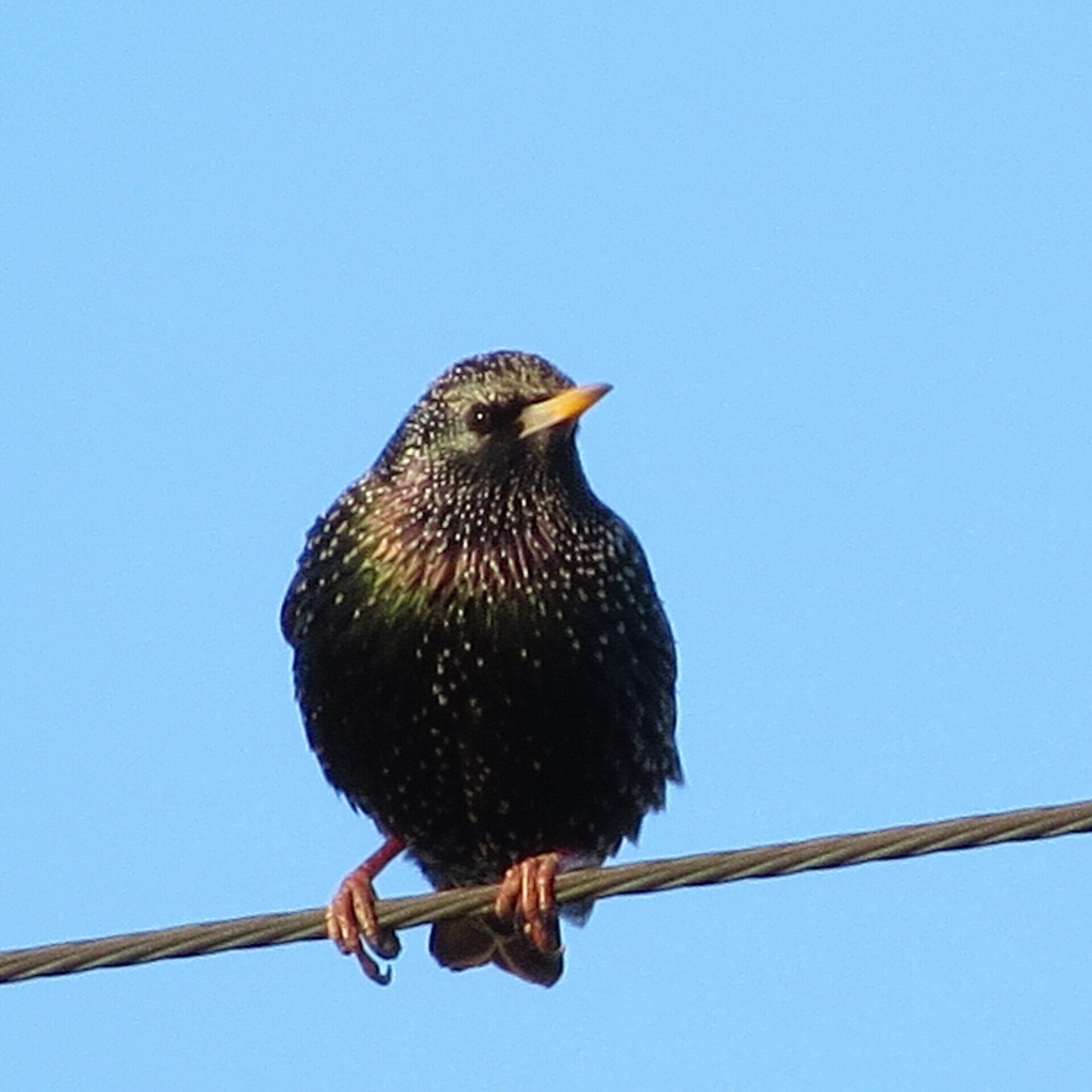
Their harm consists in out-competing native cavity-nesters for breeding sites, voracious appetite in agricultural areas, and roosting in messy swarms over water supplies. Although a group is referred to as “a murmuration” their extreme chattiness might better be called a cacophony. And it’s better not to park underneath. But some of their harm has been mitigated by the introduction of nest boxes and Bluebird trails.


They have many endearing qualities, however, and not just baked in pie. Once sold as cage birds in Europe, Mozart kept one as a beloved and musical pet. As mimics they can pick up human words, beyond just Hotspur’s cry of “Mortimer!” They are also used subjects for research into flight mechanics, sensory perception, and endocrinology. So, as invaders go, they could be worse.

Recent Posts
By Jascin N. Leonardo Finger January 12, 2026
I wrote this several years ago and have re-blogged it but the juncos are so adorable – little puffball corn niblets. And they are ubiquitous during New England winters. We all know I am not an ornithologist. I would liken myself to a very amateur birder. While I worked a great deal with my friend and mentor, Edith Andrews, over the years, particularly on her book, I still am TERRIBLE at shorebirds and warblers. Even harriers and hawks. I grew up watching birds – my parents are birders. My Dad had a primo seat at the bird venue in his study – close to the feeders and the hummingbird feeder right outside the shop keeper’s style window of his study. But (as I tend to do), I digress. What are corn niblets and birds doing in the same blog you wonder? Well, that’s what I think of when I see Dark-eyed Juncos. Their beaks remind me of a piece of a corn kernel – and thus the niblets term. Believe it or not, I had never really seen – or maybe noticed – a Junco until I was in my early 20s and my husband and I were living outside Washington, DC where he was an officer stationed with the US Coast Guard. We had a large second story deck and I was feeding the birds. It was November or December and all these little birds with white-greyish breasts and black backs with little beaks showed up. I called my Mom who said, “That’s’ a Junco!’ And probably also then thought, “Duh.” If you haven’t seen a Junco, they’re absolutely adorable and a harbinger of cold weather around these parts. Last year, I never seemed to glimpse one at all. We seem to have waves from year to year where we have a lot or they are few and far between. But in any case, I was rather excited to see one under my feeder the other day. I went back to look in my bird list and realized I never saw one in 2020 nor in 2021! Now, identification books state they have a pink-ish beak but I always see them more as a yellowy color – maybe it’s my eyes – but it’s really the size that reminds me of a kernel of corn! But take a look and let me know what you think. JNLF
By Jascin N. Leonardo Finger January 5, 2026
As Walt Whitman once wrote, “Peace is always beautiful.” Peace can mean many different things. I have used this Whitman quote above before – my Father loved Whitman. And when I quote Whitman, it makes me feel like my Father is here. Maria and her father, William, were close. In fact, even with a large family of twelve people, the Mitchells were all close. My family is close as well, though we have our moments as most, if not all, families do. As we bring to a close another difficult year in which the world and its people continue to struggle, take a moment to be thankful and to find and give peace. May you always find peace in yourself and peace with others. May our world become more peaceful and may we all learn that this small space we inhabit is shared and meant for everyone. In the echoes of one of my favorite Maria Mitchell quotes, your small step, your small gesture to another or towards helping something happen, can make a difference – more than you think. I’ll end with another quote – and a poem I have used the last few years – that is fitting and that also reminds me of another Whitman poem. JNLF In Memoriam, [Ring out, wild bells] Alfred, Lord Tennyson - 1809-1892  Ring out, wild bells, to the wild sky, The flying cloud, the frosty light: The year is dying in the night; Ring out, wild bells, and let him die. Ring out the old, ring in the new, Ring, happy bells, across the snow: The year is going, let him go; Ring out the false, ring in the true. Ring out the grief that saps the mind For those that here we see no more; Ring out the feud of rich and poor, Ring in redress to all mankind. Ring out a slowly dying cause, And ancient forms of party strife; Ring in the nobler modes of life, With sweeter manners, purer laws. Ring out the want, the care, the sin, The faithless coldness of the times; Ring out, ring out my mournful rhymes But ring the fuller minstrel in. Ring out false pride in place and blood, The civic slander and the spite; Ring in the love of truth and right, Ring in the common love of good. Ring out old shapes of foul disease; Ring out the narrowing lust of gold; Ring out the thousand wars of old, Ring in the thousand years of peace. Ring in the valiant man and free, The larger heart, the kindlier hand; Ring out the darkness of the land, Ring in the Christ that is to be.
January 1, 2026
“If you don’t look, you don’t see. You have to go and look.” -Edith Andrews
Show More