Maria Mitchell In Her Own Words

Jascin N. Leonardo Finger • April 25, 2022

April 6, 1882. Last night I went to Champney’s to a Reception . . . . My little namesake is       lovely . . . . The weather is dismal in the extreme. Lydia Dame arrived this morning. Miss Herschel called yesterday. She is very pleasing. She will probably go back to Vassar when I go . . .


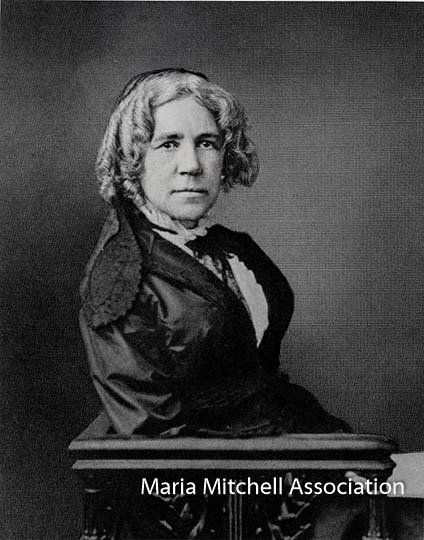
Maria Mitchell’s journals are a mixture of small daily events, her deepest thought, and discussions of science, math, and astronomy. They also show the breadth of her world – meaning the people she came into contact with and the friendships she maintained for life. This little piece is interesting because within the span of twenty-four hours so many portions of her life came together. To start with, Maria Mitchell was close to the Champney family. Lizzie Champney had been a student of Maria Mitchell’s. A prolific author, especially of adventure stories for children, Lizzie and her husband J. Wells “Champ” Champney, an artist, named their daughter after Maria. Lizzie also dedicated a book on constellations to Maria, a book which Champ illustrated. I blogged about this some time long ago. We have a portrait of Maria which was painted by Champ and was given to the MMA in 1905 by Maria Mitchell Wells Champney Humphrey, that baby named after Maria. 


Rose Herschel, daughter of Sir John Herschel, was just a small child when Maria Mitchell spent time with her famous astronomical family at the family home, Collingwood, during her trip to Europe in the 1850s. Maria Mitchell maintained a lifelong connection to the Herschels – who you may recognize, as John Herschel’s father was the famous William Herschel and his aunt was the astronomer, Caroline Herschel. When visiting them in England, Maria was the recipient of a page from Caroline’s notebook from her nephew John Herschel. I have blogged about this before. The page is in the Archives here at MMA.


And Lydia Dame is one of Maria Mitchell’s nieces. She is the daughter of Katherine Mitchell Dame, the youngest child (the tenth) of William and Lydia Mitchell. Kate, as she was referred to, married Owen Dame, a school principal and they lived in Lynn, Massachusetts. The Dame family is one of several reasons why Maria and her father moved to Lynn in 1861 after her mother passed away. Lynn also had a large Quaker population and was close to another sister of Maria’s, Phebe Mitchell Kendall, who lived in Cambridgeport. Additionally, Lynn was close to the Harvard Observatory – Maria and William were close friends of the Bonds who ran its observatory and William served on the observatory’s Board of Overseers for many years. The Mitchells and Bonds collaborated and shared research. Maria would pass away in Lynn in 1889.


JNLF


Recent Posts
By Jascin N. Leonardo Finger April 6, 2026
Well, actually replace the roof! With funding from the Community Preservation Act and the work of Lydon and Sons, Inc. the Mitchell House is getting a new roof. The current one had come to the end of its useful life. A cedar roof can last a long time – longer than asphalt – and is more historically accurate. The roof we are removing was installed in about 1992 – replacing a roof from the 1930s that was not cedar but a combination of materials that actually yes, did last sixty years. The unfortunate issue has arisen that the roofwalk (walk) has to be replaced. This is NOT the original walk – nor that old of a walk. It’s likely from the 1970s or so and has been cobbled at over time. It’s not a functioning walk – no one is allowed on it – but the Mitchell House needs it none the less. Maria Mitchell and her father, William, likely used the walk for astronomical observations – in addition to the yard – but the walk is also protected as part of the preservation easement on the House. Walks – NOT and NEVER called widow’s walks – were used for preventing and putting out chimney fire and roof fires. In a place where wood was expensive and had to be brought from “the main” these were purely utilitarian. What good Quaker (or non-Quaker) would build a platform for his wife to stare out to the harbor to see if her husband was on his way home? The other issue is that the walk was completely resting on the ridge board – and actually was notched to accept the pitch and tip of the ridge board so they couldn’t work around it. I suspect this may have been the ways walks were once built – and also a crafty and smart thinking carpenter who came up with the idea. It makes the walk lower. But between that issue and the age of the walk and then the blizzard of February 2026 that packed gusts over 83 MPH (that’s Category 1 hurricane winds) the walk gave in. Balusters had been knocked out and the railings were loose and pulling away from the posts. So, we will also be working with Barber and Sons to create a new roofwalk – and they agreed to do this for us quickly which is also no small feat given how busy everyone is these days. So from the bottom of the Mitchell House’s heart (and mine) a big thank you to Chris Lydon and Lydon and Sons and crew, Barber and Sons / Beau and Nate Barber, the Community Preservation Committee, and Nantucket Preservation Trust (our easement holder)! JNLF
By Jascin N. Leonardo Finger March 30, 2026
1882. Mch.13.3 p.m. I start for Faculty. As I sit, I feel as well as I ever did in my life; I go to Faculty and we probably shall elect what we called the “honor” girls. I dread the struggle that is pretty certain to come . . .The whole system is demoralizing and foolish. Girls study for “prizes” and not for learning when “honors” are at the end. The unscholarly motive is wearing. Maria Mitchell once said, “You cannot mark the human mind because there is no intellectual unit.” She did not like grades or prizes as you can see by her words above. I have to agree. Whether it be in academics or sports or some other activity, you should be rewarded in what you learn and how well you do – not to achieve a prize at the end. It’s the same idea with giving prizes to everyone so no one feels left out – just don’t do it. Learn how to lose gracefully.  JNLF
By Jascin N. Leonardo Finger March 23, 2026
March is Women’s History Month – though all months should be women’s history month! Maria Mitchell was one of the founders of the Association for the Advancement of Women (AAW), was its president for a term (1875), and founded its Science Committee which she chaired for the remainder of her life. When the fourth Congress of the AAW met in Philadelphia in October 1876, Julia Ward Howe (also a friend of Maria’s) was serving with Maria on the executive committee. Maria presented a paper, “The Need for Women in Science.” In it she stated, Does anyone suppose that any woman in all the ages has had a fair chance to show what she could do in science? . . . The laws of nature are not discovered by accidents; theories do not come by chance, even to the greatest minds; they are not born of the hurry and worry of daily toil; they are diligently sought, they are patiently waited for, they are received with cautious reserve, they are accepted with reverence and awe. And until able women have given their lives to investigation, it is idle to discuss the question of their capacity for original work. She is not saying that women cannot be scientists – she is saying they need to be given the opportunities. Maria was incredibly busy with the AAW – it took up a great deal of her time – and at the next meeting in November of that year some aspects of the meeting were wonderful according to her account –“excellent” papers, “newspapers treated us very well. The institutions opened their doors to us, the Centennial gave us a reception. But – we didn’t have a good time!” It appears there was discord among the women. A few opposed the subject of “Woman Suffrage,” but Lucy Stone was able to present her paper on the subject despite this. And, some women felt that the West was not well represented and was overshadowed by New England, thus women representing the western states protested the nomination and election of Julia Ward Howe as president of the AAW. But she won. Whew! It was not always easy and controversies constantly abounded with many schisms over time within the women’s rights movement. I often wonder what Maria might think of the place of women today – how far things have come from her time or would she be surprised that there still is inequality? What would she think? In honor of Women’s History Month, visit the National Women’s History Alliance, the National Women’s History Museum, and the National Collaborative of Women’s History Sites. These places will also point you in the directions of women’s history sites across the country and how to find out more information about all these women who paved the way for us!  JNLF
Show More