

The Maria Mitchell Association • 2026 Year End Appeal
"The more we see, the more we are capable of seeing."
–Maria Mitchell
Your gift keeps the sky, land, and sea open to the next child.
What a transformative year it has been at the Maria Mitchell Association!
From the magic of the first Stargazer Circus to the excitement surrounding our new Discovery Center and Aquarium, this has been a year of bold ideas, remarkable generosity, and wonderful possibilities. Watching thousands of people come together beneath the big top reminded me of something I have always believed: there is real magic in bringing our Nantucket community together around curiosity, discovery, and wonder.
But behind these exciting moments is the important work we do every day. We introduce children to the natural world, mentor young scientists, care for our island's remarkable sky, land, and sea, and preserve the historic buildings that connect us to Maria Mitchell's extraordinary legacy.
Doing this work on Nantucket comes with significant challenges. The cost of operating our facilities, providing housing for our talented seasonal staff and interns, maintaining historic properties, and delivering accessible, high-quality programs continues to rise. These are not always the most visible parts of our mission, but they are essential to everything we accomplish.
As we look ahead to the promise of our capital campaign and a new chapter for the MMA, your annual support is more important than ever. Our capital campaign will help build our future, but your annual gift sustains the people, programs, and places that make the MMA so special today.
I hope you will consider making a gift this year, and if you are able, increasing your support. Every contribution makes a meaningful difference and allows us to continue sharing the wonder of Nantucket with people of all ages.
Thank you for believing in the MMA, for being part of our community, and for helping us imagine all that is possible.
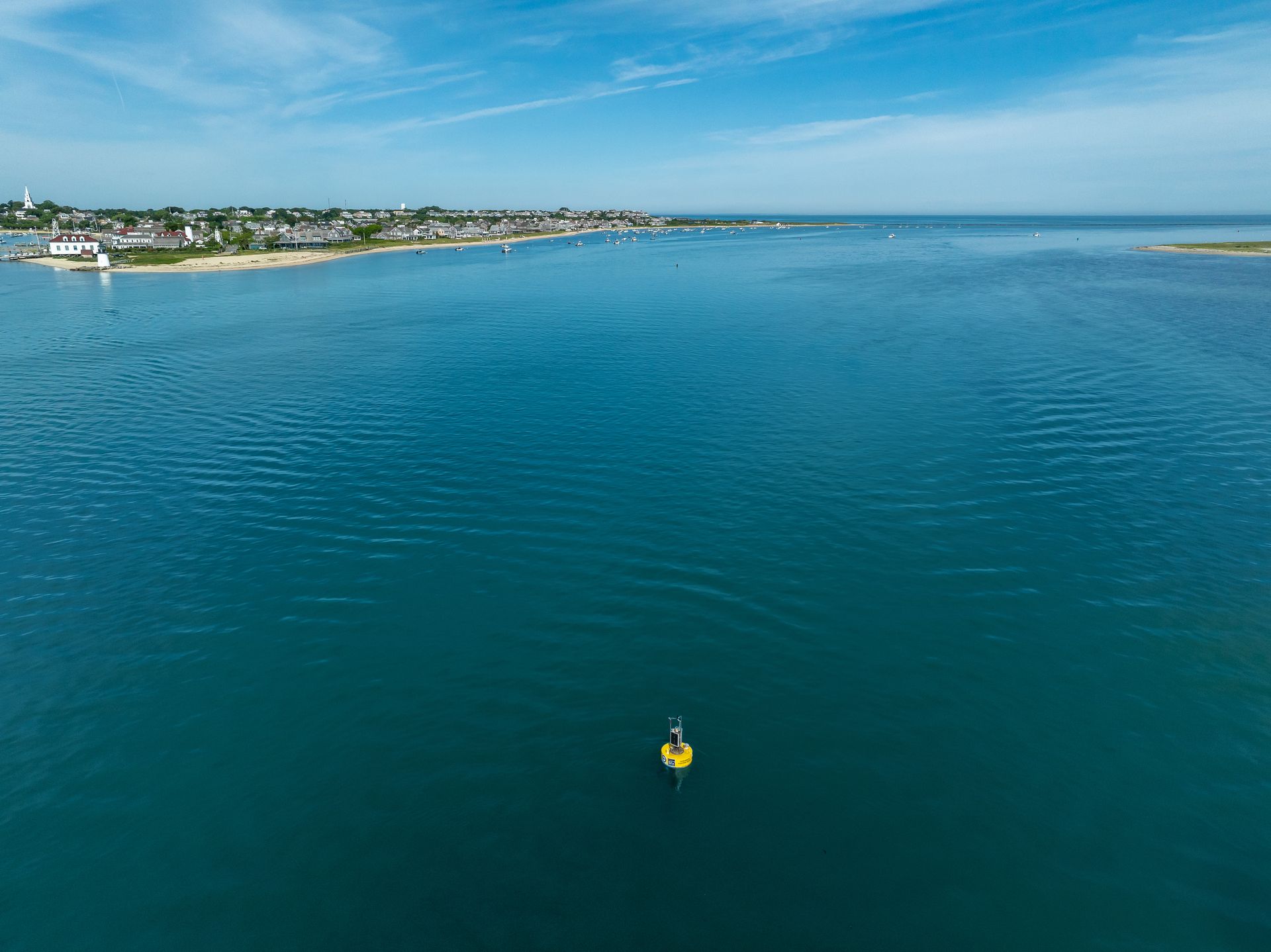
Three Examples of What the Buoy Reveals
Example 1:
Why Does Oxygen Rise and
Fall Each Day?
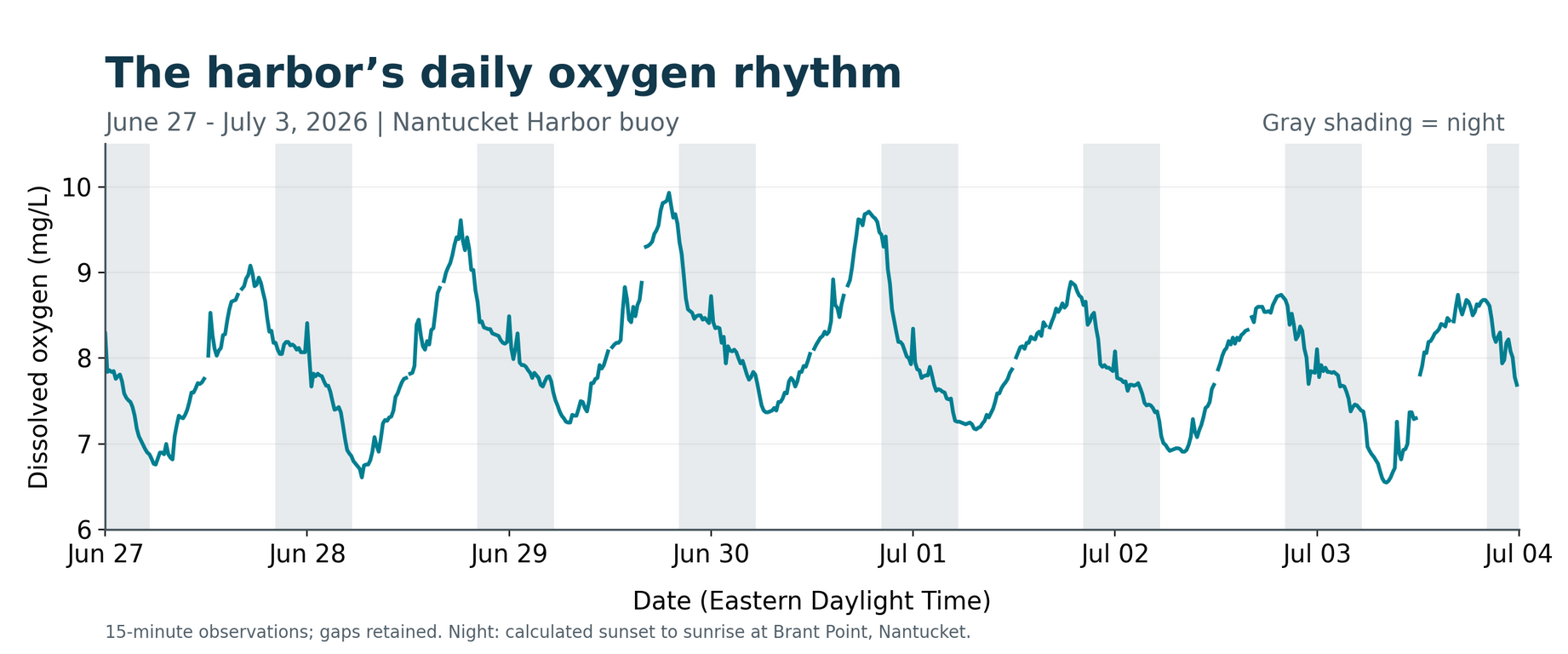
In daylight, algae and eelgrass produce oxygen through photosynthesis, while organisms continue to consume it through respiration. At night, photosynthesis stops, but respiration continues.
The graph to the right follows oxygen through a summer week, with nighttime shaded gray. Can you see oxygen generally falling overnight and rising during daylight?
Notice that the cycle repeats, but each day is a little different. Light, tides, temperature, and biological activity all help shape the oxygen measured by the buoy.
Click here to enlarge image.
Example 2:
What Happens Underwater
During a Storm?
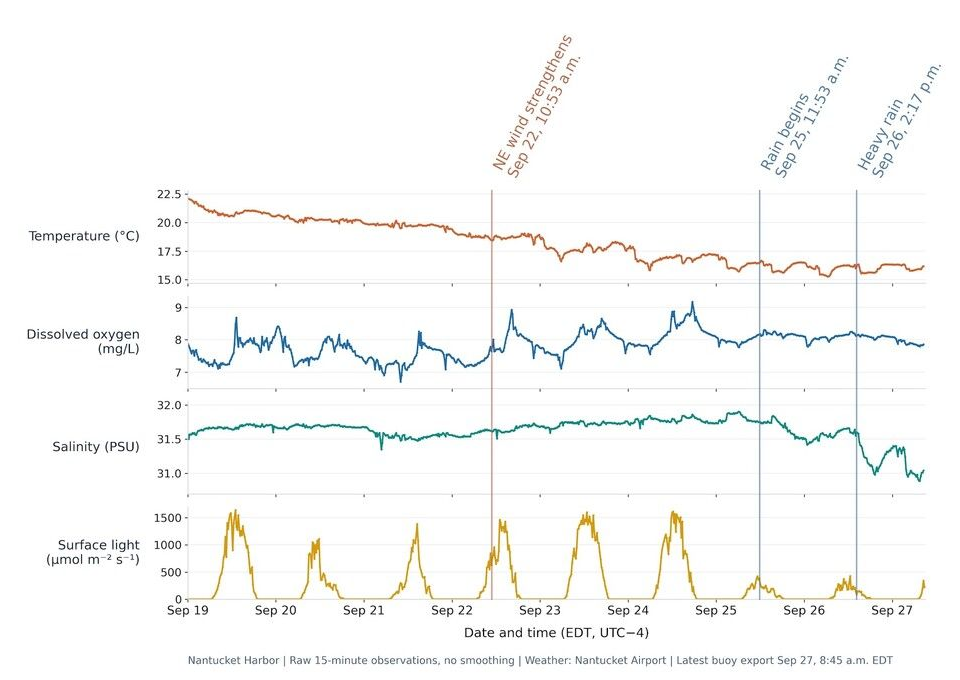
What happens to that daily rhythm when a storm arrives?
During the September 2026 nor’easter, the harbor cooled rapidly, became less salty, and its familiar daily oxygen rhythm nearly disappeared. The buoy recorded these changes as the storm unfolded.
Look for the falling temperature and salinity in the storm graph, and compare the oxygen pattern with the summer rhythm in Example 1.
What might those changes mean for life in the harbor?
Read the
Underwater Storm Story from the MMA's Senior Marine Science Advisor, Dr. Betsy Sherman in
Nantucket Current.
Click here to enlarge image.
Example 3:
When Warmth and
Low Oxygen Coincide
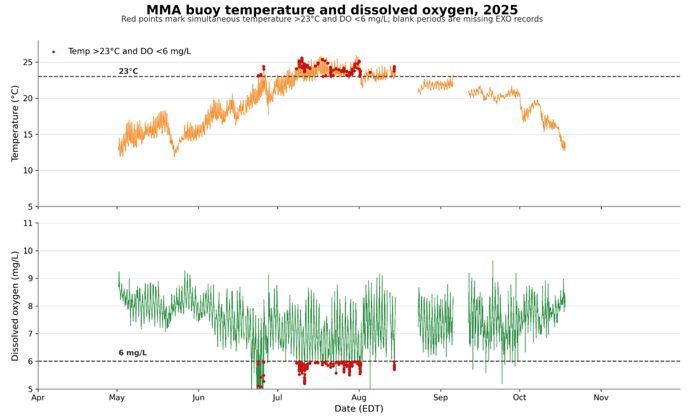
The buoy also lets us examine several conditions together. Warm water increases animals’ oxygen needs. What happens when oxygen is low at the same time?
The two panels show temperature and oxygen over the same period. Red dots mark times when water warmer than 23°C coincided with oxygen below 6 mg/L.
Notice where those dots cluster at the height of summer.
We are investigating how often these conditions overlap and how long they last, to better understand the challenges facing eelgrass, scallops, and other harbor life.
Click here to enlarge image.