

You Are a Rock!

Jascin N. Leonardo Finger • October 3, 2016

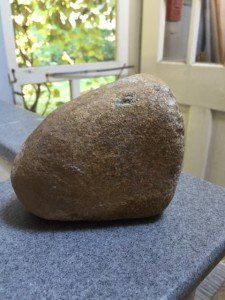
I have to say, I did tell this rock you see here, “you are a rock!” the other day. That was, after I had gone back over to the Mitchell House and I was alone of course.


For maybe eighty or so years, this rock was doing a serious job. It was a big support. I am not kidding you. The other day, I was handed this rock by the mason – Wayne Morris and his mason tender, his daughter Andrea – while I stopped in to check on the work in the basement of our soon to be Research Center. Andrea pulled the rock out of a bucket. Wayne said, “You know where that was?” Turns out this rock was filling a void between a support beam and a concrete block – basically acting as a filler to hold it all in place.


Now, before we all exclaim, “What?!” we have to think about when and how this was done. It was done in the 1920s, so the gentleman who did this was likely born in at least the 1870s. That – and his growing up and beginnings of work life – being a time when he would have learned from and been trained by carpenters and others who worked in the mid-nineteenth century. So this rock, while something we would not do today, was a perfectly acceptable building material in the 1920s still.

I have seen this before – not just in our historic MMA buildings but all around Nantucket and even off-island. I sit on the board of a very old organization here on the island and recently when we had work done to a building we found boulders and large rocks being used to hold up building and landscaping components from the nineteenth century. Heck, there are still many foundations on island that are rubble or even one rock holding up a long expanse of a sill. It works, still does, may very likely to continue to work even when we are all dead and gone. They knew how to build then – with limited building technologies compared to today.


Despite all this, the rock is not going back. But it will live on as a testament to the builders of our past!


JNLF

Recent Posts
By Jascin N. Leonardo Finger July 6, 2026
July 15. {1863} My dear Sally . . . I think Mitchell is all right in his algebra. He can’t stand an examination in Trig but I don’t believe he will have a rigorous one. Father has seen the Prof. and will give him a letter to them.  If you can’t be honest with your sibling, who can you be honest with? Apparently, Sally Mitchell Barney’s son, William Mitchell Barney – known as Mitchell as his cousin William Mitchell Barney was known as Willie (how is that for honoring your father?!) – was visiting his aunt Maria and his grandfather, William Mitchell, at their home in Lynn, MA. Sally still lived on Nantucket and I suspect Mitchell was not only visiting but getting some much needed help with his mathematics by his aunt Maria. As always, she is brutally honest – he won’t pass a test in trigonometry (but, neither would I!). JNLF
By Jascin N. Leonardo Finger June 29, 2026
In April and early May, at long last, the Mitchell House roof was replaced. (I noted this in an earlier blog.) I had also noted that the roofwalk, given the condition it was in and its location – sitting on the ridge – had to be replaced. They had thought they could jack it up – as they have done with other walks – but the Blizzard of February 2026 that was ALL wind (83 MPH winds – read Category 1 Hurricane) and no real snow, made the walk impossible to treat in such a manner (read: crumble). So, after much discussion, review by our preservation easement holder, and permits, as well as some fundraising, we are replacing the roofwalk. The prior walk was not the original. The original blew off in a gale in the late nineteenth century, replaced at some point in the 1930s, and likely replaced again in the 1960s or 1970s. Then, since that time, it was heavily repaired. Its framing members were notched to accept the ridge boards (read: peak) of the roof and I think that may have been an original way to construct a walk. Makes perfect sense – and gives the walk more support and a lower profile. It was after all about putting out chimney fires and preventing roof fires. People copied what worked – and there have been a few others noted to be built in this manner still. It presents an issue though – because if you need to work on the ridge board or close to it – you cannot get to it easily – I guess you may be able to access it to some extent by lifting the deck boards of the walk. The new Mitchell House roofwalk will sit about six inches above the ridge – which will also allow air to circulate better over the ridge and the shakes in that area. That is the only thing that will really be different. It is protected by a preservation easement – as part of the Mitchell House’s easement – and frankly, even if we did not have an easement, we would not want it to look any different. So keep your eyes to the skies at 1 Vestal as we work to re-build the walk. With a special thank you to Barber and Sons and Lydon and Sons. JNLF
By Jascin N. Leonardo Finger June 22, 2026
1875, June 20. A meeting of the Officers of Congress was called at the house of Mrs. Hanaford, 5 Summit Ave., Jersey City. The weather was intensely cold. I went to New York on the 19 th and stopped with my friend Mrs. Clapp, 100 W. 54 St . . . .It was a question who should preside. Mrs. Hanaford thought the Chairman of the Executive Committee should and I had been told that I should, etc. The question was decided by the non-arrival of the Chairman of Ex.Com. I called them to order at an hour after the time appointed. Of course I made many blunders, as I have never presided before, but I continued for 4 hours. We did a few good things . . . The thing most weighing on Maria’s mind at this meeting was the looseness of membership for the Congress. She felt people were not being vetted properly in some areas of the country and thus they may allow in “undesirables.” I would take this to mean women who were not entirely behind the cause of the Congress and the Association for the Advancement of Women. I am not surprised by her suspicions and likely she was correct – one could see naysayers gaining access to this group and trying to destroy it from the inside. The women’s rights movement would have many schisms within it as people disagreed and broke into smaller factions.  Another important thing to point out is that Mrs. Hanaford is Nantucket-born Phebe Coffin Hanaford. Raised a Quaker, like Maria, Coffin Hanaford would become the first woman Universalist minister in New England – among many other firsts. She grew up with Maria, attended and taught at the Coffin School here on Nantucket, and was a founding member of another women’s organization, Sorosis, which Maria was also a founding member of. It’s nice to see two sister Nantucketers continuing to work together as adults – far from home! JNLF
Show More