
The Back Porch

Jascin N. Leonardo Finger • January 28, 2019

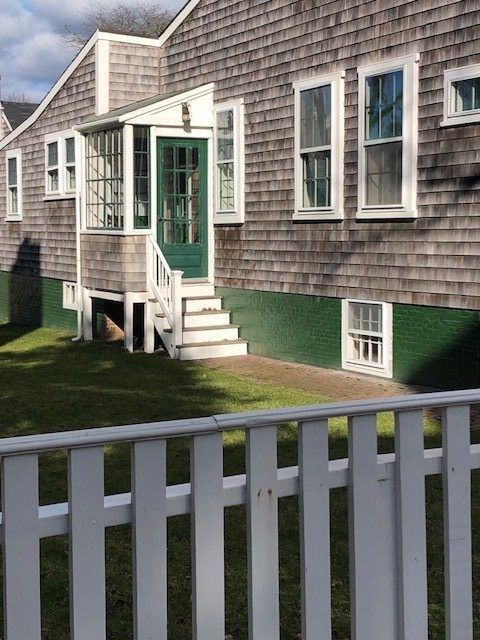
I love this simple 1920s/1930s back porch. It speaks to me of a simpler time but also a time in which even with a little addition, the remainder of the house is untouched – much of this house seems untouched. It likely enters the kitchen. It’s a place where you can come in, dust the snow of your shoulders, pound the snow off your shoes. Take them off. Hang your old plaid wool coat on the hook and maybe sit on the bench – if there is room for one – and pull off your boots before entering the warm kitchen. In the kitchen, the potbelly stove still exists. Now, a newer gas oven and stove exist in this kitchen but the potbelly still warms the space. The table has an enamel top with a small red decoration along the edges that make it look like the top has a tablecloth on it. The sink is a large, one basin square porcelain sink with built in porcelain drains on either side, at an angle, so water runs off of them. Your mother washes her hair in the sink – every Friday evening in the winter and then dries it sitting in front of the pot belly, gently coming and toweling it dry. She does the same to you.


On Nantucket, we have lost a lot of these little additions or warts as we call them. Yes, its not original to the house but it shows the evolution of the house just like an outhouse and a scallop shack or shed or an early garage with a bi-fold door. Outbuildings and warts are all important – it shows how the house was used and how the use of the house evolved as new inventions came to be and new ways of living developed. It shows how we lived.


JNLF

Recent Posts
By Jascin N. Leonardo Finger May 11, 2026
A repost – with my apologies – from last year. It started budding the week of April 30 this year. This is what our landscaper for the MMA calls it. “The ancient vine.” He tells the people who work for him not to touch the “ancient vine.” I have probably made him – and all of them – terrified of it. I am even terrified of it to some degree. I refer to the grape vine behind the Mitchell House that is supposed to be Peleg Mitchell Junior’s grape vine – Maria Mitchell’s uncle who inhabited the house from about 1836 to his death in 1882. It has two trunks but one died several years ago. Because of that, each year I try to root shoots. It’s fairly easy to do – when you cut back the vine in late fall/early winter. I have had success but not success protecting the shoots I baby all winter from bunnies and other critters once I plant them – try as I might. I started doing this when the one trunk died – I was PANICKED! The landscaper stays away because I have told him if anyone is going to accidentally harm or worse yet, kill, this grape vine it would be me so I only have myself to blame. So each November/December – once ALL the leaves have fallen off – I climb my ladder and quietly, carefully, and fearfully cut back the stems typically to two buds. I have been somewhat successful in spurring grape production – and these grapes attract some amazing birds in the fall. It takes me some time – and I pretty much hyperventilate the entire time – and then, I stare at it all winter. Passing under it multiple times a day to reach my office. Hoping, and yes, praying, it will come out in the spring. It’s a late budder so just recently the buds started to show themselves – thank goodness! – and I was rewarded today (May 5, 2025) with this wonderful hot pink color on the edges of the leaves as they are uncurling. JNLF
By Jascin N. Leonardo Finger May 4, 2026
May 6, 1878 Between the clouds, Miss Spalding obtained 7 photographs of Mercury on the Sun. It is comfort to me to be able to plan and do a new kind of work. The large telescope worked better than usual, Clark having just been to the Observatory. Clark, as in Alvan Clark, a man who would become the premier telescope maker in America and who built Maria Mitchell’s 5-inch Alvan Clark refractor that she purchased from him (after working with him to build it per her specifications) with money gifted to her from “The Women of America” led by Elizabeth Peabody. More than likely, it is this telescope she is referring to as she did use it in the Vassar College Observatory with her students – and it is also taking center stage in photographs, along with her (first her father’s) Dolland telescope.  Maria had decided she would photograph the Sun on every clear day, and this was one of those results. She would use these images, with her students, to study sun spots and their changes. With her students, Maria would photograph the transit of Mercury as noted above. She would also photograph the transit of Venus a few years later with her students. JNLF
By Jascin N. Leonardo Finger April 27, 2026
And with it, some of the heirloom daffodils I purchased for the Mitchell House last fall. A place was recommended to me by two longtime friends of the MMA and gardeners extraordinaire. It is called Old House Gardens. I ordered a small amount as we now have a plethora of voles on Vestal Street – I believe I complained about them here last year. They won’t eat daffodils so I got a few of “Butter and Eggs” (1777) and “Conspicuus” (1869) as either of these could have appeared in William Mitchell’s gardens. They were not listed in a letter from John Quincy Adams that I have mentioned before. But, Adams was not here visiting the Mitchell family when the daffodils would have been in bloom. The one pictured here is “Butter and Eggs” not completely unfurled. JNLF
Show More