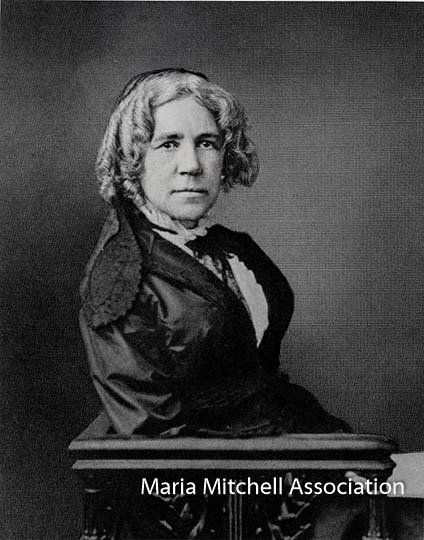

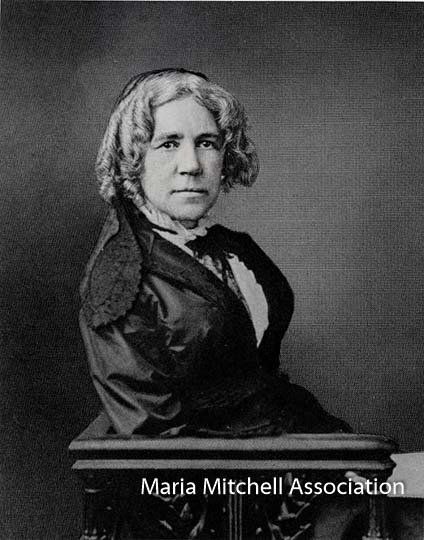
Maria Mitchell In Her Own Words

Jascin N. Leonardo Finger • January 14, 2019

Jan. 1, 1855.I put some wires into my little transit this morning. I dreaded it so much, when I found yesterday that it must be done, that it disturbed my sleep. It was much easier than I expected.


I have blogged later portions of this adventure before. This is the earliest account in the line – I did it backwards. Maria would try to fix the lines in her transit with her own hair, then her nephew’s hair, and finally found success in using spider webs – individual strands! Talk about patience – but also ingenuity and need! The transit was important to Maria’s work – transits are still used today including for surveying. They are used to determine the relative position of objects and lines. They are extremely precise instruments and are used to establish reference lines and provide readings of angles in precise measurements. Until she made the repairs, some of her work would have come to a screeching halt.


JNLF

Recent Posts
September 1, 2026
“If you don’t look, you don’t see. You have to go and look.” -Edith Andrews
By Jascin Leonardo Finger August 31, 2026
I’m sure you’ve seen it as you trek about the island – near the beaches and ponds. This image is of the swamp or marsh mallow that we have on Vestal Street in our garden out front of the Observatory. It can grow in drier places – though it’s not as lush as at Capaum Pond or out in Quaise. It’s in the Hibiscus family – and is fairly tropical looking and always a delight to see.  “When in bloom, one of the most showy plants of the Island, for a mass of the magnificent, large flowers on the edge of a blue pond causes one’s heart to thrill at the wealth of deep pink colour . . .” from Nantucket Wild Flowers, Alice O. Albertson (cousin of Maria Mitchell), 1921. JNLF
By Jascin N. Leonardo Finger August 24, 2026
I have always wanted to find a piece of a clay pipe. I know – weird – but if you have ever read any of my blogs here for the MMA then you know I have a thing for pottery shards. I sort of figured I would not find a piece of a clay pipe – not even a piece of a stem. But the other day, walking in a place where I have found quite a few shards, I found a piece of clay pipe! Now, I’m not talking about water pipes – I am talking about tobacco pipes. And I know very little about clay pipes. Yes, I am a curator of a historic house museum, but this family did not smoke. They were Quaker and among the many things they abstained from, tobacco was one of them. Therefore, I am not up on clay pipes so I am doing a bit more research.  For one, age can be determined by the width of the hole inside the pipe. So based on this one, I would say it’s fairly late. Since they were so fragile, and those holes pretty small, if it got filled with tobacco, the person just broke off the stem creating a shorter pipe and one that was not clogged with tobacco. Apparently, stems could be recycled – in fact, 15,000 broken stem pieces were uncovered at a historic walkway at Colonial Williamsburg – they were used as fill! And pipes were made into the early twentieth century – falling out of favor around World War One. It makes sense – they were cheap, easy to make, and affordable. Typically, one could last a few years – unless you dropped it of course. An,d pipes were used by men, women, and (eh, em) yes, children. I can see that Nantucket may not have had a lot of tobacco smoking residents – not just that some were Quaker – but because of the Quaker influence. I t does not mean people here do not smoke – I just think there may have been fewer smokers on the island in the nineteenth century and earlier. JNLF
Show More