Conservation Work Has Begun at the MMA Library!
Jascin N. Leonardo Finger • September 30, 2013

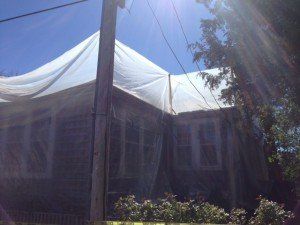
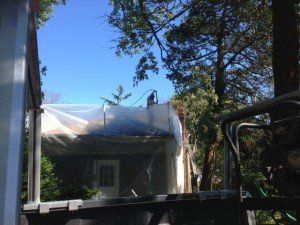
On September 16th, the MMA began the work to the exterior of the MMA Science Library – soon to be an ecology lab and classroom space, as well as state-of-the-art storage for our natural science collections.


With Community Preservation Act funding, the roofer arrived to begin the work. This is a special roof, made mostly of concrete tiles and completed in the 1930s when the stucco Wing was added to serve as a fireproof space for Maria Mitchell’s papers, her library, family papers and libraries, and the MMA’s Special Collections. Long ago, some poor repairs were completed to the tiles when they broke (but that said, long ago they did not necessarily have the technology and knowledge that we do today for proper conservation of such a roof). Additionally, the roof had, over the last thirty or so years, grown a very interesting moss and lichen coating which delighted in the northern exposure that faces Vestal Street.


With about a week’s worth of work, Jim Johannes of Asbestos-One in Ohio assessed the roof further, removed and cleaned the moss and other debris growing on the tiles and one day we had a brilliantly white looking roof. The roof was not originally this color. Over time, it bleached out and the coating that it had come from the manufactory with had disappeared. Now, in the second week, Johannes is re-coating the roof so that it is back to what it was when it left the factory in the 1930s. It is a nice, deep charcoal color – what it was when it was installed in the 1930s.


Next step will be the work of island mason, Wayne Morris, who will work on the stucco, the terracotta tiles, and the oxide jacking that is occurring. Stay tuned – I will keep you posted as the work progresses and give you more details about what his work entails!


A special thanks to the Community Preservation Committee for its support of this important conservation project.


JNLF

Recent Posts
February 5, 2026
NANTUCKET, MA—On the occasion of the 247th American Astronomical Society (AAS) Meeting, and the 179th anniversary year of the discovery of Maria Mitchell’s Comet, the 2025 astronomy interns from the Nantucket Maria Mitchell Association (MMA), journeyed to Phoenix, AZ, to represent the MMA and present their research. Building on the legacy of Maria Mitchell, the first female American astronomer, the MMA offers STEM research and education opportunities to interns from across the country via their paid internship programs. The MMA’s Maria Mitchell Observatory has operated a National Science Foundation funded Research Experiences for Undergraduates (REU) program for decades. The REU is funded by a generous grant from the U.S. National Science Foundation (NSF) which allows the MMA to bring six undergraduate students to Nantucket each summer. These talented and promising students are selected out of a pool of hundreds of applicants from across the United States. From January 4 – 8, 2026, the MMA’s most recent NSF-REU students presented their work at the winter AAS meeting on subjects ranging from the characteristics of dust around and between stars, to various aspects of supernova explosions. MMA Director of Astronomy, Dr. Jackie Milingo, attended the conference and presented each student with a bound volume of their collected research papers. “The MMA’s long-standing REU program has nurtured hundreds of budding scientists over many decades. It’s always inspiring to see these students shine and make the most of this extraordinary opportunity. We’re a small program with an outsized effect on not only these students, but the future of the scientific community.” The 2025 REU students and their respective presentations are listed below. The common theme of their research was dust. This dust is made of familiar elements like carbon, oxygen, silicon and iron is similar to grains of sand or ash. Even though these dust grains are a small part of our Galaxy, they are very important because they can block the light coming from everything astronomers study. Understanding this dust helps us to understand how it is formed and how it affects the light that must travel vast distances across our Milky Way to get to our telescopes. This past summer’s NSF-REU interns and their research presentations which they presented at the AAS are: Madison Gerard (University of Texas at Austin) : SN 2024abfl: An Absolutely Flat and Low-Luminosity Interacting Type II Supernova Kaylee Perez (Texas State University) : Exploring the Link Between Dust Extinction and Attenuation with Simulated Data LaurenBarkey (CaliforniaPoly Pomona) : Peek-a-Boo: Exploring the NEOWISE Lightcurves of RCoronae Borealis Stars Aiden Agostinelli (University of Montana) and Ben Radmore (University of Michigan) : When the Dust Settles: Late-Time MIRI Imaging of SN 2011ja Image: 2025 NSF-REU Interns, Madison Gerard, Lauren Barkey, Benjamin Radmore, Aidan Agostinelli, and Kaylee Perez with MMA Director of Astronomy, Dr. Jackie Milingo.  The Maria Mitchell Association was founded in 1902 to preserve the legacy of Nantucket native astronomer, naturalist, librarian, and educator, Maria Mitchell. After she discovered a comet in 1847, Mitchell’s international fame led to many achievements and awards, including an appointment as the first professor of astronomy at Vassar College. Maria Mitchell believed in “learning by doing” and today that philosophy is reflected in the MMA’s mission statement, programs, research projects, and other activities. The Maria Mitchell Association operates two observatories, a natural science museum, an aquarium, a research center, and preserves the historic birthplace of Maria Mitchell. A wide variety of science and history-related programming is offered throughout the year for people of all ages. ###
February 4, 2026
NANTUCKET, MA— The Nantucket Maria Mitchell Association (MMA) welcomes Susan Vizurraga for a discussion of her book Williamina Fleming, Astronomer, an imagined memoir. As one of the Harvard College Observatory’s (HCO) women computers Williamina Fleming led a fascinating life. She was, an immigrant, a working mother, and an astronomer and her story will be brought to light in this engaging presentation on the remarkable legacy of a woman who helped transform modern astronomy from behind the scenes. Through Fleming’s own imagined voice, Vizurraga explores Williamina’s journey from domestic servant to internationally respected scientist, her pivotal role in classifying stellar spectra, and her quiet perseverance in a male-dominated field. This talk celebrates Williamina Fleming not only for her scientific achievements, but also for her resilience, curiosity, and lasting impact on how we understand the stars. This free event will be held via Zoom on Wednesday, February 18, from 7–8 pm. Susan Vizurraga is the author of the historical fiction novel-in-verse Williamina Fleming, Astronomer, an imagined memoir based on the life of the real-life Scottish immigrant who began work as a maid, joined the HCO as one of many women computers, and became the discoverer and curator of stars. A former middle school teacher and university instructor, Vizurraga is the author of the picture books Our Old House (a Junior Library Guild Selection) and Miss Opal’s Auction (a multi-generational selection of the National Council for the Social Studies). She is a volunteer docent at the Georgia Museum of Art and a poll worker with her local elections board. She lives in rural southern Oconee County, Georgia. This event will be held via Zoom. Pre-registration is required. To register for the free, virtual event, use the registration link: https://us06web.zoom.us/webinar/register/WN_SVlPAu9ITmmQll_E9aU3aw#/registration The Science Speaker Series is generously sponsored by the Maria Mitchell Association’s lead sponsor, Bank of America. The Maria Mitchell Association was founded in 1902 to preserve the legacy of Nantucket native astronomer, naturalist, librarian, and educator, Maria Mitchell. After she discovered a comet in 1847, Mitchell’s international fame led to many achievements and awards, including an appointment as the first professor of astronomy at Vassar College. Maria Mitchell believed in “learning by doing” and today that philosophy is reflected in the MMA’s mission statement, programs, research projects, and other activities. The Maria Mitchell Association operates two observatories, a natural science museum, an aquarium, a research center, and preserves the historic birthplace of Maria Mitchell. A wide variety of science and history-related programming is offered throughout the year for people of all ages. ###
By Jascin N. Leonardo Finger February 2, 2026
Maria Mitchell once said, “When I see a woman sew, I think, what a capacity she has for using a micrometer!” So, maybe what I am about to write would be a bit disappointing to her. However, I believe she was likely pleased by what sewing circles on Nantucket could accomplish for her fellow Nantucketers. As, the great-granddaughter of a milliner and extremely talented seamstress (she hand-smocked about twenty dresses for me when I was an infant and did all of that with rheumatoid arthritis!) and the granddaughter of two talented women of sewing and needlework, my apologies to Maria . . . . The sewing circles that arose on Nantucket in the nineteenth century were formed in part because of the Great Fire of 1846, which, along with the demise of whaling and the lure of the Gold Rush, helped to bring about an economic depression that would last decades and cause Nantucket’s population to decrease from its height of around 10,000 in the 1830s to fewer than 2,000 people by the late nineteenth century. The sewing circles helped struggling families by providing them with clothes, food, and even paying their rent. Many of the organizations rose from within the churches of the island and all were founded, managed, and run by women. The Ladies Union Circle of the First Congregational Church, established in 1846, was followed by similar groups, such as the Unitarian Sewing Society and the Ladies Wesleyan Society of the Methodist Episcopal Church, both established in 1850. The women gathered together to create, sew, and sell their creations to raise money for those in need and for their own churches. The groups not only generated the money to help others; they also provided a social venue for those who remained on Nantucket and witnessed the quickly deteriorating social fabric of their island home. The societies served as a positive network and support group for their members. The women’s activities, accomplished many good deeds, and one group, the Unitarians, was even able to purchase a parish house for the church with funds they raised – no small task. Additionally, the sewing circles gave rise to other groups that many islanders heavily relied upon in the nineteenth century: the Relief Association, the Children’s Aid Society, and the Ladies Howard Society, which could date its beginnings to the era of the American Revolution. The Relief Association is still in existence today; assisting island families in need. The act of helping your fellow islander is something that has been a constant on Nantucket, back to when the first English came to the island to settle in 1659. Some of it is born of the isolation of the island, but it is largely that the island is akin to one big family and that is what you do, you take care of your family. JNLF
Show More