


MMA's Nantucket Harbor
Buoy Monitoring Project
Monitoring Water Quality Parameters to Better Understand the Health of Nantucket Harbor
The MMA’s Harbor Monitoring Project seeks to better prepare our community to detect and respond to water quality changes by expanding our understanding through direct Nantucket Harbor research and interdisciplinary collaborations on data analysis. This project is collecting and publishing a continuous data stream on temperature, dissolved oxygen, salinity, pH and various measures of water clarity.
These parameters will provide the public and cross-agency decision makers with essential, real-time information for more effective conservation, mitigation, and management of critical habitats and the valuable commercial and recreational fisheries that depend on them. Continuous monitoring permits us to understand the conditions that the harbor organisms are actually experiencing, moment by moment.

Why Nantucket Harbor?
Nantucket’s waters are home to one of the last remaining commercially viable wild bay scallop fisheries, and young scallops depend on eelgrass.
Nantucket Harbor has lost more than half of its eelgrass cover since 2006. That loss is one reason we watch the harbor so closely: what conditions are eelgrass and bay scallops living through?
Photo of the Nantucket Harbor Monitoring Buoy in Nantucket Harbor by Yellow Productions.
Example 1:
What Happens Underwater During a Storm?
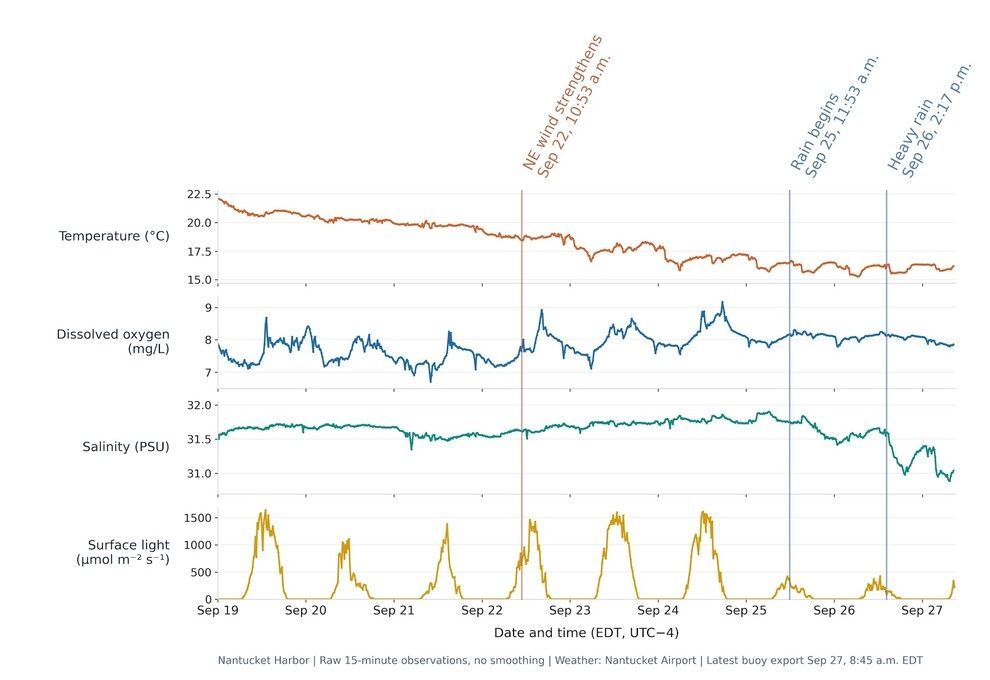
We feel the wind and rain and watch the harbor churn. The buoy lets us follow the storm beneath the surface, too.
During the September 2026 nor’easter, the buoy recorded cooling water, dimmer daylight, and a drop in salinity following heavy rain.
What might those changes mean for life in the harbor?
Read the story in Nantucket Current.
Example 2:
When Warmth and Low Oxygen Coincide
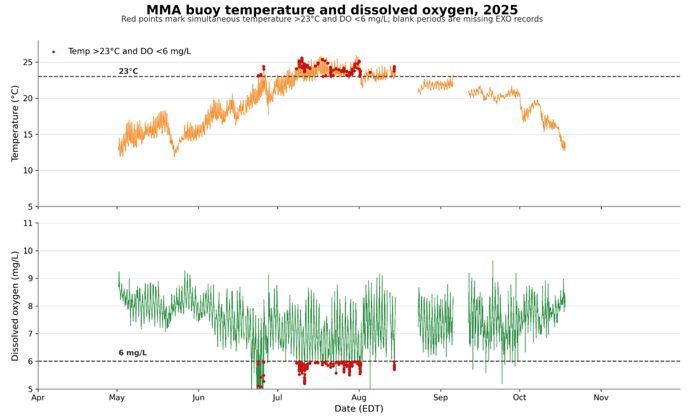
Water temperature and oxygen each tell us something about conditions in the harbor. But what happens when the water is warm and oxygen is low at the same time?
The red dots in the graph to the right mark those moments.
We are investigating how often these conditions overlap and how long they last, to better understand the challenges facing eelgrass, scallops, and other harbor life.
About the Buoy
In response to an existing data gap, a YSI EMM-700 Bay Buoy was deployed in August 2024 at the mouth of Nantucket Harbor. Of particular interest were temperature, dissolved oxygen, pH and algae levels, as there has been no real-time, continuous data collection for these parameters.
All sensors are maintained automatically by a self-cleaning wiper system that prevents biofouling and allows for long-term deployment. The buoy is equipped with a set of solar panels which recharge the central battery and can extend sampling periods to several months.
Data are collected and transmitted via cellular uplink every 15 minutes, making the information available in nearly real-time to our team and the general public.