
And We Have Our Research Center C.O.

Jascin N. Leonardo Finger • April 9, 2018

Otherwise known as Certificate of Occupancy – from the Town!


Our Research Center passed its inspection with the Town and now we are in the midst of cleaning, installing blinds, washing windows, and moving things around. We await moving the collections in and new collections cabinets to arrive. This summer, we will be up and running and there will be plenty of opportunities to take a peek. You will find that the “renovation” was very light – taking into account the historic nature of the building and its historic fabric. Once William Mitchell’s schoolhouse, it lived on Howard Street and after he sold it, it actually followed him to Vestal Street where it continued as a school, including for the Town as the West Introductory School.


When the MMA was given the building in 1919, it was picked up and moved less than 100 feet to sit where it does now. It opened as the MMA Science Library in the early 1920s. The stucco Wing was added in 1933.


We have gone to great lengths to preserve the exterior and interior of the building while making minor alterations for an accessible bathroom and accessible pathway, a laboratory-like space which has counters and a sink built into the existing library shelving, and a new state-of-the-art HVAC system for the collections’ protection. I think anyone familiar with the interior of the building will note that it has not changed much. But, with new coats of paint, some updated furniture for students and researchers, we are on our way to a better space in which the MMA can conduct its research, store its historic biological collections, and welcome students and researchers alike to learn about the unique environment of Nantucket – from the land to the water to the skies above.


JNLF

Recent Posts
By Jascin N. Leonardo Finger February 2, 2026
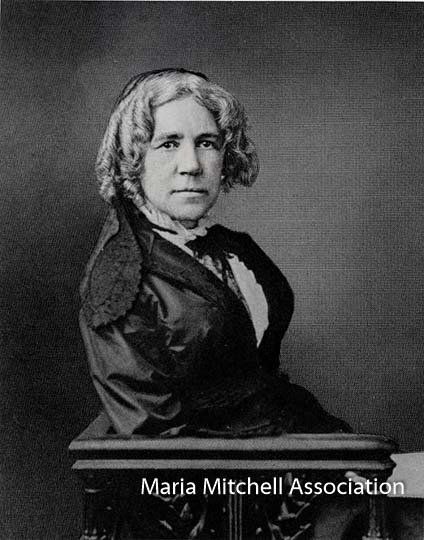
Maria Mitchell once said, “When I see a woman sew, I think, what a capacity she has for using a micrometer!” So, maybe what I am about to write would be a bit disappointing to her. However, I believe she was likely pleased by what sewing circles on Nantucket could accomplish for her fellow Nantucketers. As, the great-granddaughter of a milliner and extremely talented seamstress (she hand-smocked about twenty dresses for me when I was an infant and did all of that with rheumatoid arthritis!) and the granddaughter of two talented women of sewing and needlework, my apologies to Maria . . . . The sewing circles that arose on Nantucket in the nineteenth century were formed in part because of the Great Fire of 1846, which, along with the demise of whaling and the lure of the Gold Rush, helped to bring about an economic depression that would last decades and cause Nantucket’s population to decrease from its height of around 10,000 in the 1830s to fewer than 2,000 people by the late nineteenth century. The sewing circles helped struggling families by providing them with clothes, food, and even paying their rent. Many of the organizations rose from within the churches of the island and all were founded, managed, and run by women. The Ladies Union Circle of the First Congregational Church, established in 1846, was followed by similar groups, such as the Unitarian Sewing Society and the Ladies Wesleyan Society of the Methodist Episcopal Church, both established in 1850. The women gathered together to create, sew, and sell their creations to raise money for those in need and for their own churches. The groups not only generated the money to help others; they also provided a social venue for those who remained on Nantucket and witnessed the quickly deteriorating social fabric of their island home. The societies served as a positive network and support group for their members. The women’s activities, accomplished many good deeds, and one group, the Unitarians, was even able to purchase a parish house for the church with funds they raised – no small task. Additionally, the sewing circles gave rise to other groups that many islanders heavily relied upon in the nineteenth century: the Relief Association, the Children’s Aid Society, and the Ladies Howard Society, which could date its beginnings to the era of the American Revolution. The Relief Association is still in existence today; assisting island families in need. The act of helping your fellow islander is something that has been a constant on Nantucket, back to when the first English came to the island to settle in 1659. Some of it is born of the isolation of the island, but it is largely that the island is akin to one big family and that is what you do, you take care of your family. JNLF
February 1, 2026
“If you don’t look, you don’t see. You have to go and look.” -Edith Andrews
By Jascin N. Leonardo Finger January 26, 2026
January 18, 1858. Before I left Marseilles I took a carriage and with Miss Shepard and the Hawthorne children visited the best parts of the city and then the seaside . . .On Sunday morning {January 17} at 8 o’clock we left Marseilles for Genoa and Leghorn, uncertain what our further destination would be. Mr. Hawthorne’s indecision is so great that the termination of our journey together is very uncertain . . . I have noted before that Maria Mitchell would travel through parts of Europe with Nathaniel Hawthorne, his wife, Sophia Peabody Hawthorne, and their children. She expressed her frustrations with Hawthorne – as you can see above – in multiple ways. Further on she notes, that if he had been, “as agreeable in conversation as he is in writing“ which gives you a deeper insight. Here was America’s first woman astronomer getting an intimate experience with the Hawthorne family. She did become quite close to Sophia and the children and I have noted before, Maria would act as their impromptu governess or teacher. Hawthorne was finally swayed in making a decision when his daughter, Una, noted that both Maria and Miss Shepard desired visiting Rome as did she. JNLF
Show More