
Nantucket Maria Mitchell Association REU-NSF Interns Attended the 245th American Astronomical Society Meeting in Washington, D.C.
NANTUCKET, MA—On the occasion of the 245th American Astronomical Society (AAS) Meeting, and the 178th anniversary year of the discovery of Miss Mitchell’s Comet, interns from the Maria Mitchell Association (MMA) of Nantucket Island, journeyed to Washington, D.C., to represent the MMA and present their work. Building on the legacy of Maria Mitchell, the first female American astronomer, the MMA offers STEM research and education opportunities to interns from across the country via their paid internship programs.
The MMA’s Maria Mitchell Observatory has operated the National Science Foundation- Research Experiences for Undergraduates (NSF-REU)- program each summer for decades. The program is funded by a generous grant from the National Science Foundation, which allows the MMA to bring six top undergraduate students to the MMA each summer who are selected out of a pool of approximately 380 applicants from around the United States.
January 12 -16, the MMA’s Summer 2024 NSF-REU interns presented their research on fascinating subjects, from finding baby stars, to understanding how galaxies grow over time, and how dark matter influences galaxy cluster collisions. MMA Executive Director, Joanna Roche, attended the conference and presented each student with a bound book of their cohort’s papers. “The research and projects that this year’s REU interns presented are as fascinating as they are well done. We are so proud to continue the tradition of nurturing young scientists through our REU program.”
This summer’s NSF-REU interns and their research presentations which they presented at the AAS are:
Naija Bruckner | Rice University, majoring in Astrophysics, presented “Probing Circumgalactic Medium Turbulence with Synthetic Absorption.” Her topic was turbulence in the circumgalactic medium (the gas around galaxies). By examining snapshots of simulated galaxies at different redshifts, she found that higher ions are better tracers of turbulence and movement of gas in the CGM than low ions. This finding can be used to improve our interpretation of observed CGMs and the movement of gas within by looking at absorption lines particular to higher ions in actual observation.
Sophia Chan Davis | University of Michigan, double majoring in Astronomy & Astrophysics and Interdisciplinary Physics with a minor in Museum Studies, presented “Shining the X-ray light on Planetary Nebulae in Globular Clusters.”. She focused on investigating the origins of planetary nebulae in globular clusters, utilizing advanced X-ray observations to enhance our understanding of stellar evolution. Her findings suggest its X-ray emissions come from shock interactions within the nebula, making K648 the most distant planetary nebula with X-ray emission ever observed.
Jillian Epstein | Cornell University, majoring in Engineering Physics and minoring in Astronomy, presented “Searching for X-ray Counterparts of Protostellar Cores.” She is interested in optics and astrophysics with a particular interest in high-energy astrophysics, cosmology, and astrophysical instrumentation. She used archived Chandra X-ray Observatory data to research the X-ray components of protostars under Dr. David Principe from the MIT Kavli Institute. Epstein utilized the CAIO suite of tools in Python to analyze X-ray spectra.
Fiona Lopez | Texas A&M University, majoring in Physics and Astronomy, presented her research titled “Understanding the Interplay Between Dust, Gas, and Stars in High-Redshift Galaxies with ALMA and JWST” in collaboration with Dr. Mónica Relaño from the University of Granada, Spain. Her work explores the complex roles of interstellar dust, gas, and stars in high-redshift galaxies, leveraging observations from ALMA and the James Webb Space Telescope (JWST) to gain deeper insights into these distant cosmic systems.
Nicolas Mazziotti | University of Arizona, majoring in Astronomy and Physics, presented, “Exploring Dark Matter and Galaxy Clusters.” His presentation at AAS was about his MMA research with Dr. Lindsay King (UT Dallas) on simulations of merging galaxy clusters.
Gada Tefera | Pomona College, majoring in Computer Science, presented “Investigating the Impact of sub-DLAs on the Neutral Hydrogen Mass Density of the Universe.” He focused on investigating the contribution of sub-Damped Lyman Alpha systems to the neutral hydrogen content of the early universe using spectra from the KODIAQ DR3 sample of 727 quasars. He developed and implemented spectroscopic analysis methods using Python tools, including LineTools and XSpectrum1D, to identify and characterize absorption systems. He led a systematic search resulting in the identification of 555 absorbers, including 415 sub-DLAs, representing one of the largest high-redshift sub-DLA samples ever assembled. He performed analysis of absorption features and metal line systems to determine column densities and metallicities across redshift range 2 < z < 6.
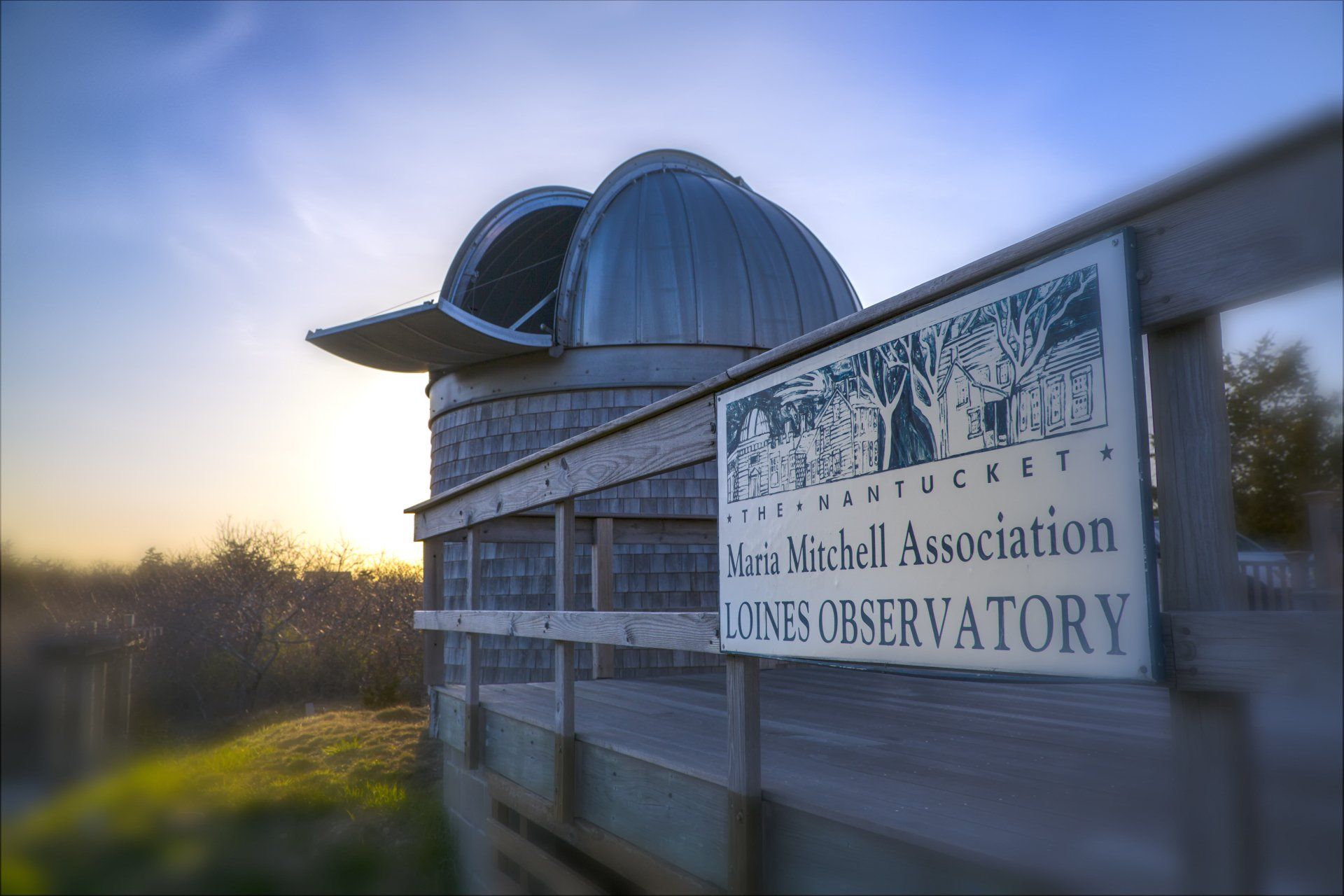
The Maria Mitchell Association was founded in 1902 to preserve the legacy of Nantucket native astronomer, naturalist, librarian, and educator, Maria Mitchell. After she discovered a comet in 1847, Mitchell’s international fame led to many achievements and awards, including an appointment as the first female professor of astronomy at Vassar College. Maria Mitchell believed in “learning by doing” and today that philosophy is reflected in the MMA’s mission statement, programs, research projects, and other activities. The Maria Mitchell Association operates two observatories, a natural science museum, an aquarium, a research center, and preserves the historic birthplace of Maria Mitchell. A wide variety of science and history-related programming is offered throughout the year for people of all ages.
####
For Immediate Release
January 24, 2025
Contact: Joanna Roche
jroche@mariamitchell.org
Recent Posts