
Keep Calm and Bird On: July 2023

Ginger Andrews • June 30, 2023
“If you don’t look, you don’t see. You have to go and look.”
-Edith Andrews
On Nantucket July means summer is just getting under way. But in the Arctic, the post-solstice return of darkness is already noticeable. And this means the beginning of shorebird migration. Didn’t we just see them, enroute to northern nesting grounds? But the short Arctic season means they only get one chance to raise young, and they must do it quickly. The shift in daylight means that some of the bird world’s longest-distance migrants are already thinking about heading south.

Some pause only briefly on our beaches; some stay all winter. They don’t necessarily all move at once. Non-breeders may lag behind on wintering grounds. Some may have been delayed by bad weather, lack of food, or injury; others await maturity before attempting the rigors of raising young.

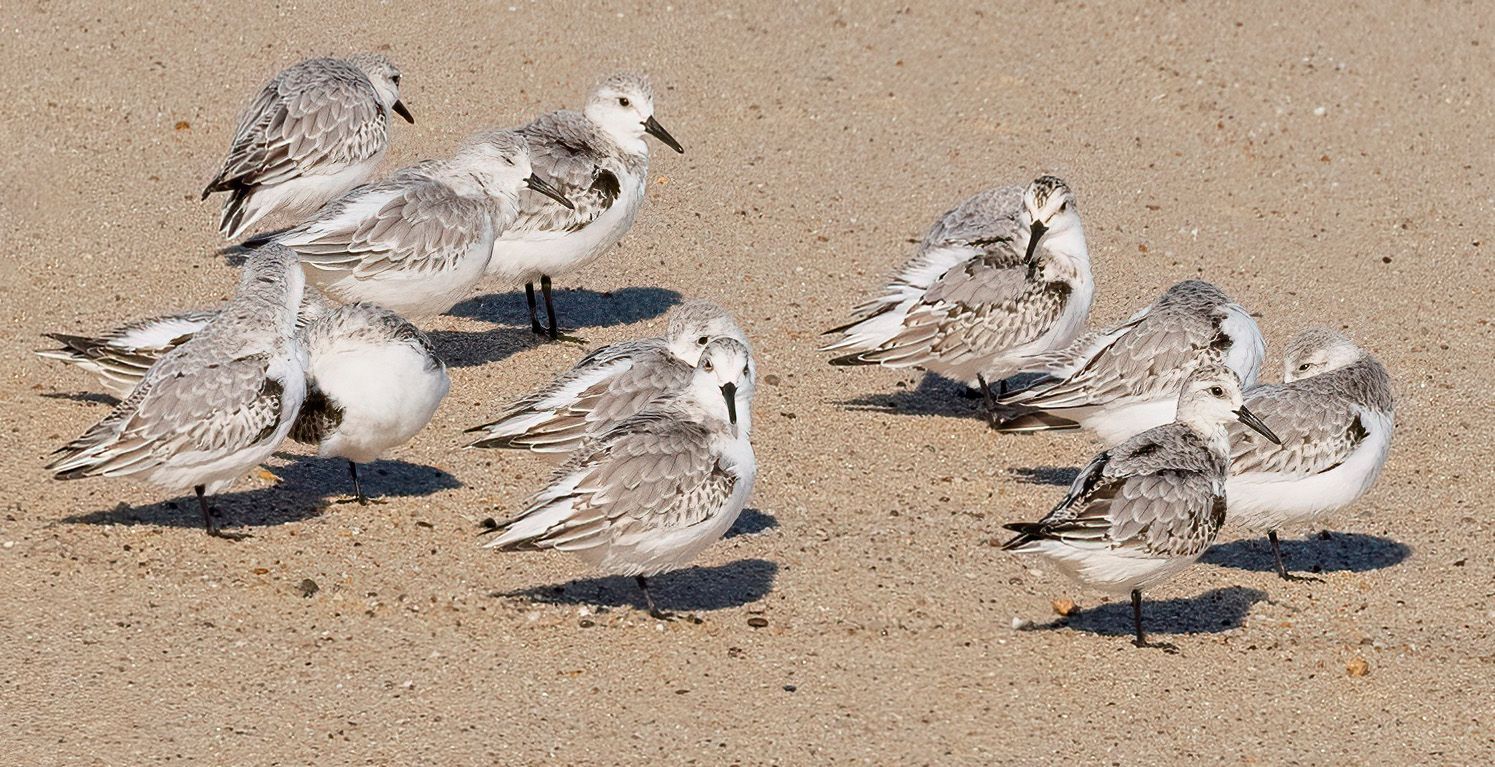
Sanderlings are perhaps everyone’s favorite shorebird; they are so active, running back and forth between waves, almost never caught. We are used to seeing them in winter grey and white, but in early summer a few might still be sporting the rufous feathers of the breeding season. Their black legs churn like wind-up toys as they run; their black bills disappear as they probe the damp sand. They are finding amphipods, small crabs, and marine worms. Oddly, they can cast a pellet with the indigestible bits as owls do. They are not averse to insect foods; in a pinch they can eat plant material.

They feed together in flocks, starting with smaller numbers, six to perhaps a dozen, but as the season progresses flock size increases. In July, they are just returning from Canadian islands in the high Arctic. They are heading for sandy beaches all over the world. On the east coasts in the Americas we may see them anywhere from Massachusetts to Tierra del Fuego.


Photo by Tom Griswold

Recent Posts
By Jascin N. Leonardo Finger April 27, 2026
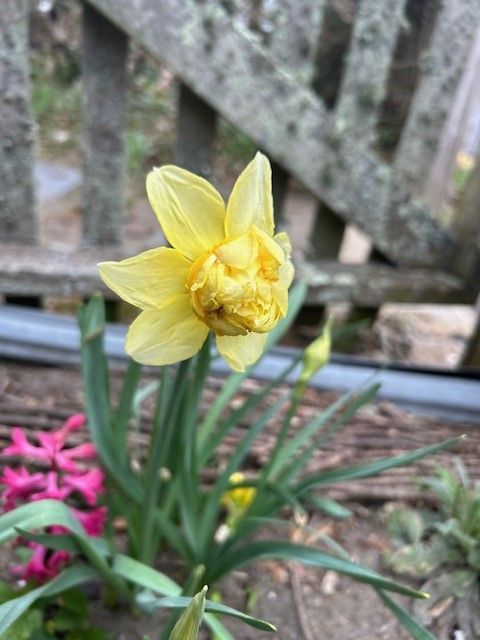
And with it, some of the heirloom daffodils I purchased for the Mitchell House last fall. A place was recommended to me by two longtime friends of the MMA and gardeners extraordinaire. It is called Old House Gardens. I ordered a small amount as we now have a plethora of voles on Vestal Street – I believe I complained about them here last year. They won’t eat daffodils so I got a few of “Butter and Eggs” (1777) and “Conspicuus” (1869) as either of these could have appeared in William Mitchell’s gardens. They were not listed in a letter from John Quincy Adams that I have mentioned before. But, Adams was not here visiting the Mitchell family when the daffodils would have been in bloom. The one pictured here is “Butter and Eggs” not completely unfurled. JNLF
By Jascin N. Leonardo Finger April 13, 2026
April 1878. The conference of Woman’s Congress officers met in Washington. Because we had one member in Washington we were invited to meet in that place. I went on at a great expense of time, money and strength . . . . We were in session at least nine hours. I think that more than half of that was used by Mrs. Spencer and Mrs. Sayles. The only motion which I carried through was to pay the Secretary $200 . . . In 1878, that was a long train(s) ride to Washington, DC from Poughkeepsie, NY and Vassar College. If Maria seems perturbed, I am sure she was. As president of the Association for the Advancement of Women, and thus the Congress, she had to be at the meeting. But it appears she did not get much say in the nine hour meeting. This was also a long trip to take when she had another, even longer trip coming up in July of 1878. In that month, she would travel with students and her sister, Phebe, out west to Colorado to view the eclipse and that train and wagon ride I am sure was weighing on her mind – not just the physical trip but making her way for an important eclipse viewing event. JNLF
By Jascin N. Leonardo Finger April 6, 2026
Well, actually replace the roof! With funding from the Community Preservation Act and the work of Lydon and Sons, Inc. the Mitchell House is getting a new roof. The current one had come to the end of its useful life. A cedar roof can last a long time – longer than asphalt – and is more historically accurate. The roof we are removing was installed in about 1992 – replacing a roof from the 1930s that was not cedar but a combination of materials that actually yes, did last sixty years. The unfortunate issue has arisen that the roofwalk (walk) has to be replaced. This is NOT the original walk – nor that old of a walk. It’s likely from the 1970s or so and has been cobbled at over time. It’s not a functioning walk – no one is allowed on it – but the Mitchell House needs it none the less. Maria Mitchell and her father, William, likely used the walk for astronomical observations – in addition to the yard – but the walk is also protected as part of the preservation easement on the House. Walks – NOT and NEVER called widow’s walks – were used for preventing and putting out chimney fire and roof fires. In a place where wood was expensive and had to be brought from “the main” these were purely utilitarian. What good Quaker (or non-Quaker) would build a platform for his wife to stare out to the harbor to see if her husband was on his way home? The other issue is that the walk was completely resting on the ridge board – and actually was notched to accept the pitch and tip of the ridge board so they couldn’t work around it. I suspect this may have been the ways walks were once built – and also a crafty and smart thinking carpenter who came up with the idea. It makes the walk lower. But between that issue and the age of the walk and then the blizzard of February 2026 that packed gusts over 83 MPH (that’s Category 1 hurricane winds) the walk gave in. Balusters had been knocked out and the railings were loose and pulling away from the posts. So, we will also be working with Barber and Sons to create a new roofwalk – and they agreed to do this for us quickly which is also no small feat given how busy everyone is these days. So from the bottom of the Mitchell House’s heart (and mine) a big thank you to Chris Lydon and Lydon and Sons and crew, Barber and Sons / Beau and Nate Barber, the Community Preservation Committee, and Nantucket Preservation Trust (our easement holder)! JNLF
Show More