
Keep Calm and Bird On: August 2023

Ginger Andrews • July 31, 2023
“If you don’t look, you don’t see. You have to go and look.”
-Edith Andrews
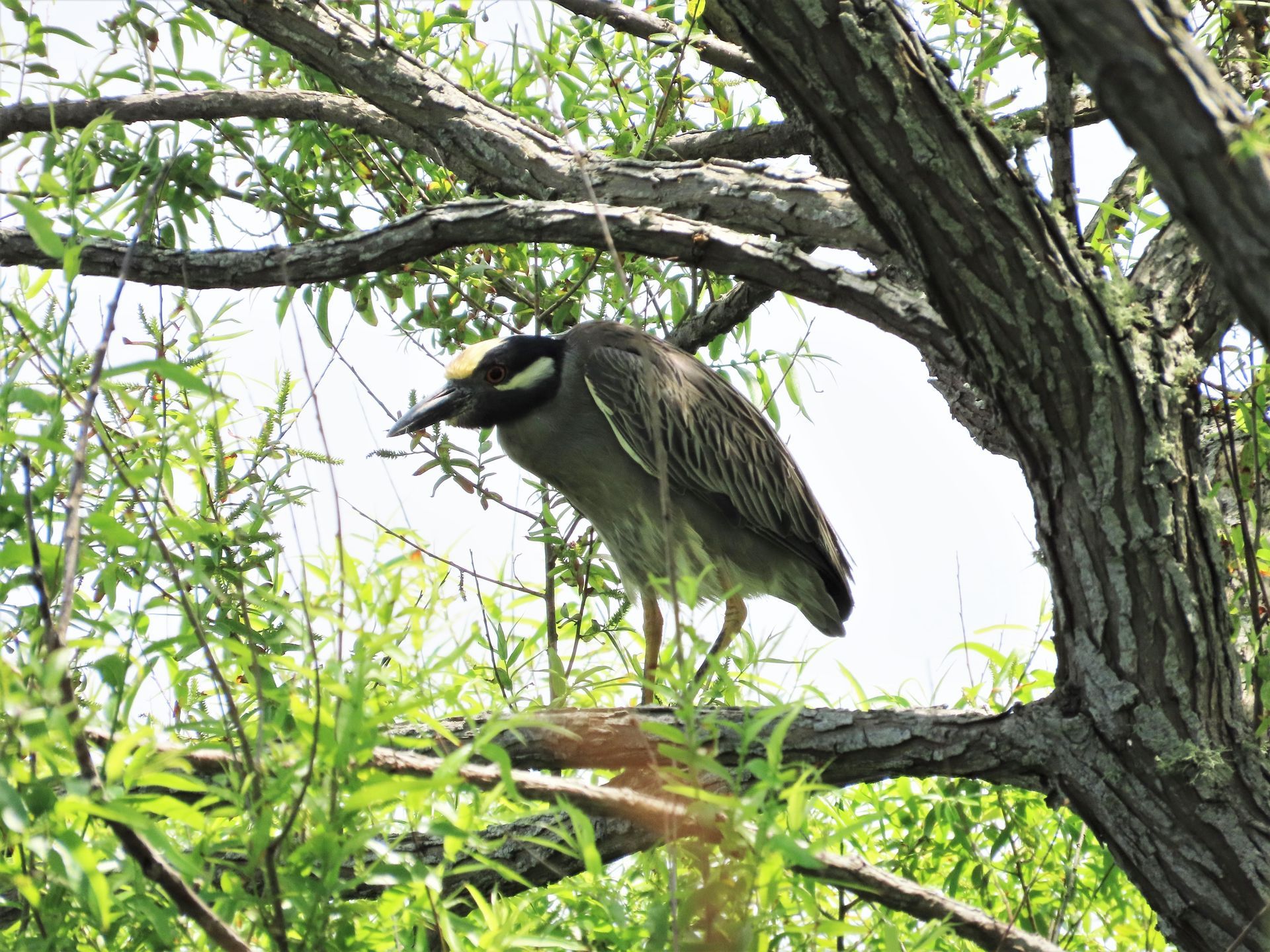
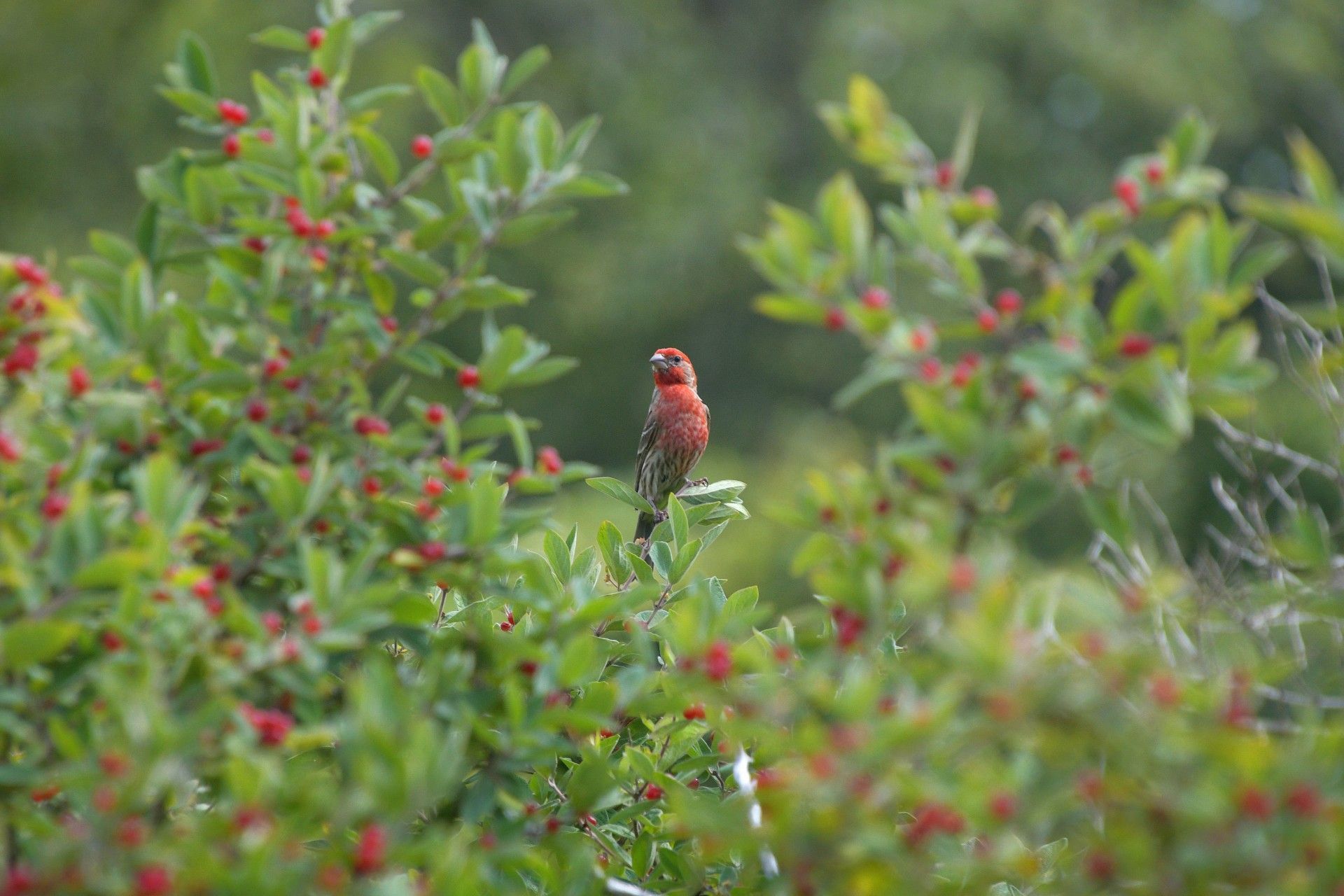
On Nantucket, August is a peak time for Shorebirds. But our inland breeding birds are also worthy of attention. Birds of the year—HY as in “Hatch Year” to bird banders—are flopping around learning the ropes. Their curiosity is entertaining. Some, like the Red-bellied Woodpecker, are new here. Seen mainly in winter for several years, they are now breeding. 

As the bird life of a place changes, we need to keep reporting those changes. Over the years we have seen a lot of birds, once unknown here, become common. Some, like the Carolina Wren, have moved up from the south with climate change. Others are experiencing restoration to their former territory when some hazard has been removed. 

Many—perhaps most of us—use the Cornell website eBird to keep our lists. It is now one of the largest “citizen science” programs in the world, providing vital data to researchers and wildlife managers. So, with changes in our world, reporting becomes ever more important. When something pops up as “rare” and the eBird algorithm flags it, don’t assume that just because the machine knows more, by volume, that your identification lacks weight. Never be afraid to argue with an algorithm, or it will never learn. So, take the time to respond. 

But the corollary is that good data is essential. Photographs or sound recordings are best. But detailed written descriptions can also be used. To discourage wishful thinking, draw or write down what you observed first, before consulting a book or website. Think of a common look-alike and ask yourself how you would advocate for that if it was what you really wanted to see. Then check yourself against higher authority, and humbly change your mind if necessary. Anyone can make a mistake. But think of science, and take the time to correct yourself when you get it wrong. You’ll be glad you did. 


Photo by Photo by Trish Pastuszak

Recent Posts
By Jascin N. Leonardo Finger April 13, 2026
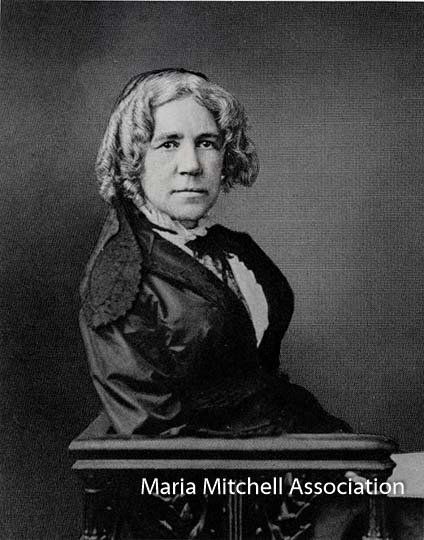
April 1878. The conference of Woman’s Congress officers met in Washington. Because we had one member in Washington we were invited to meet in that place. I went on at a great expense of time, money and strength . . . . We were in session at least nine hours. I think that more than half of that was used by Mrs. Spencer and Mrs. Sayles. The only motion which I carried through was to pay the Secretary $200 . . . In 1878, that was a long train(s) ride to Washington, DC from Poughkeepsie, NY and Vassar College. If Maria seems perturbed, I am sure she was. As president of the Association for the Advancement of Women, and thus the Congress, she had to be at the meeting. But it appears she did not get much say in the nine hour meeting. This was also a long trip to take when she had another, even longer trip coming up in July of 1878. In that month, she would travel with students and her sister, Phebe, out west to Colorado to view the eclipse and that train and wagon ride I am sure was weighing on her mind – not just the physical trip but making her way for an important eclipse viewing event. JNLF
By Jascin N. Leonardo Finger April 6, 2026
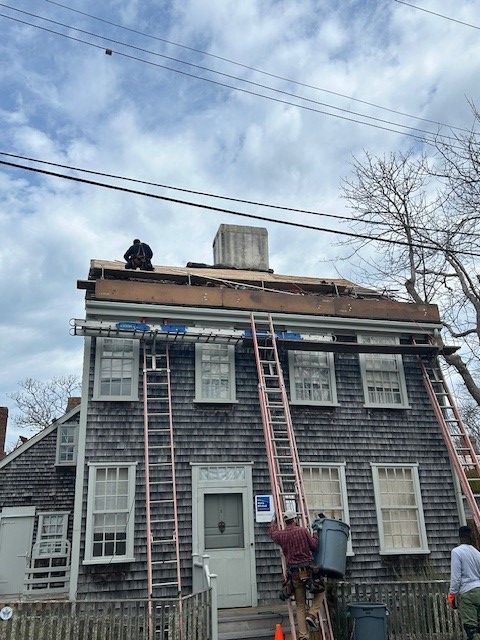
Well, actually replace the roof! With funding from the Community Preservation Act and the work of Lydon and Sons, Inc. the Mitchell House is getting a new roof. The current one had come to the end of its useful life. A cedar roof can last a long time – longer than asphalt – and is more historically accurate. The roof we are removing was installed in about 1992 – replacing a roof from the 1930s that was not cedar but a combination of materials that actually yes, did last sixty years. The unfortunate issue has arisen that the roofwalk (walk) has to be replaced. This is NOT the original walk – nor that old of a walk. It’s likely from the 1970s or so and has been cobbled at over time. It’s not a functioning walk – no one is allowed on it – but the Mitchell House needs it none the less. Maria Mitchell and her father, William, likely used the walk for astronomical observations – in addition to the yard – but the walk is also protected as part of the preservation easement on the House. Walks – NOT and NEVER called widow’s walks – were used for preventing and putting out chimney fire and roof fires. In a place where wood was expensive and had to be brought from “the main” these were purely utilitarian. What good Quaker (or non-Quaker) would build a platform for his wife to stare out to the harbor to see if her husband was on his way home? The other issue is that the walk was completely resting on the ridge board – and actually was notched to accept the pitch and tip of the ridge board so they couldn’t work around it. I suspect this may have been the ways walks were once built – and also a crafty and smart thinking carpenter who came up with the idea. It makes the walk lower. But between that issue and the age of the walk and then the blizzard of February 2026 that packed gusts over 83 MPH (that’s Category 1 hurricane winds) the walk gave in. Balusters had been knocked out and the railings were loose and pulling away from the posts. So, we will also be working with Barber and Sons to create a new roofwalk – and they agreed to do this for us quickly which is also no small feat given how busy everyone is these days. So from the bottom of the Mitchell House’s heart (and mine) a big thank you to Chris Lydon and Lydon and Sons and crew, Barber and Sons / Beau and Nate Barber, the Community Preservation Committee, and Nantucket Preservation Trust (our easement holder)! JNLF
April 1, 2026
“If you don’t look, you don’t see. You have to go and look.” -Edith Andrews
Show More