Keep Calm and Bird On: April 2022

Ginger Andrews • March 25, 2022
“If you don’t look, you don’t see. You have to go and look.”
-Edith Andrews
The arrivals and departures only increase as spring progresses. We continue to watch recently arrived American Oystercatchers, Ospreys and Piping Plover.

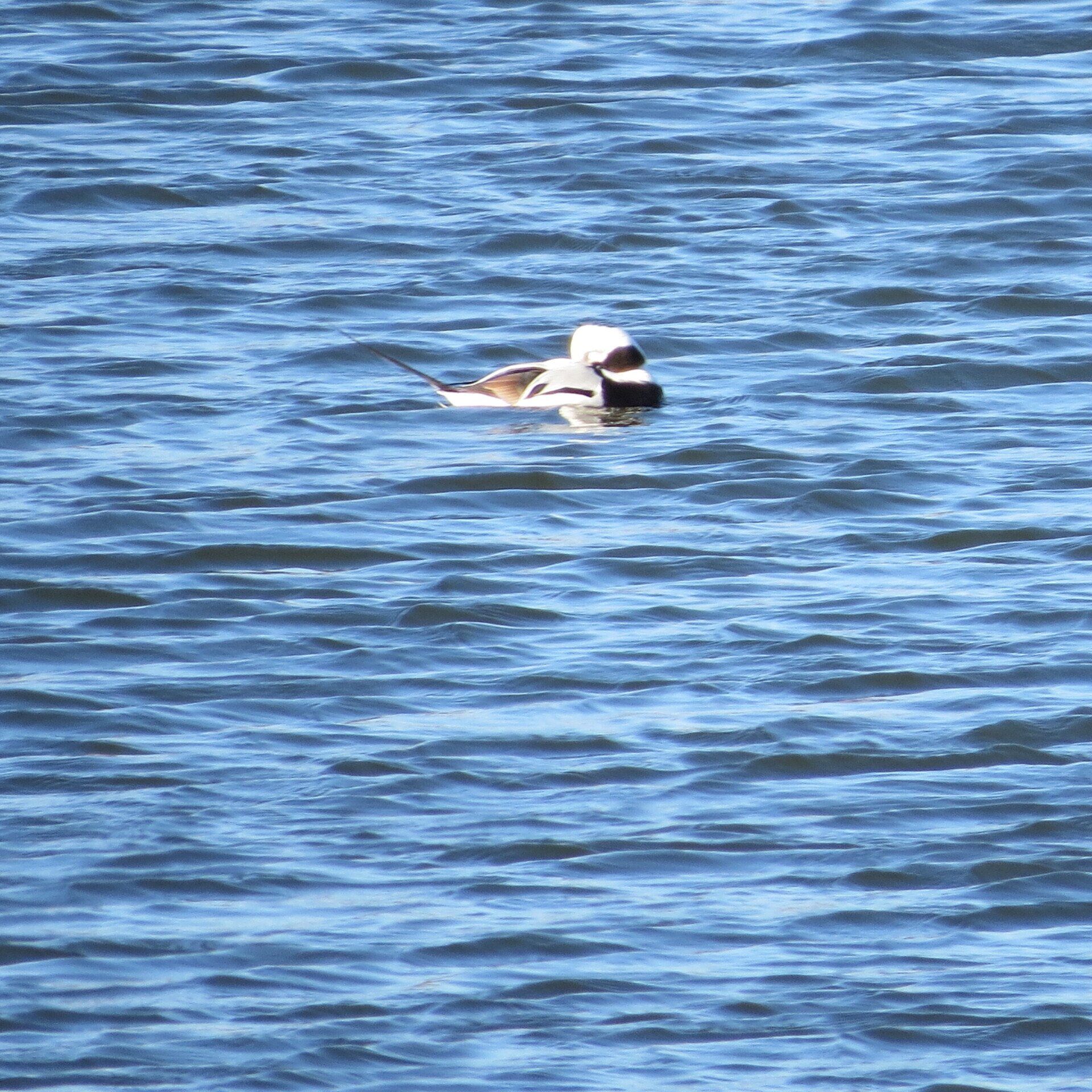
But it is still worth getting in those last looks at the winter sea ducks: Black, White-Winged and Surf Scoters, not to mention Bufflehead, Harlequin and Long-tailed Ducks. Long-tailed Ducks—some of us who are older remember them as “Oldsquaws”—are particularly of interest as their numbers have varied so much over time. The huge flocks of the mid-1980’s and early 2000’s have not been seen for the last few years. And as a pelagic species, spending much time out of sight of land, it is difficult for researchers to get an accurate sense of how many there are. We do know that the big flights of yore coincided with big concentrations of food, in the form of gaminid amphipods, on a shoal about 50 miles southeast of Nantucket. Almost 10% of the estimated world population passed by our shores, going by the north shore and Great Point in the morning, returning back along the south shore and Madaket in the afternoon, and cutting overland sometimes in the fog, yodeling their haunting calls as they flew over. We count them one by one just now, to find out how many are still around here.  

And for sheer enjoyment, listen for the eerie keening of Black Scoters, gathering in large rafts off Sconset to prepare for migration. Their voices were supposed to be part of the origin of that mythical beast, the Tuckernuck Yo-ho. And enjoy watching behaviors: many of the northern ducks are pairing up here or along the way. Watch for feisty courtship displays: head-bobbing, yodeling, bowing, synchronized swimming, and a lot of splashing.

Recent Posts
By Jascin N. Leonardo Finger May 4, 2026
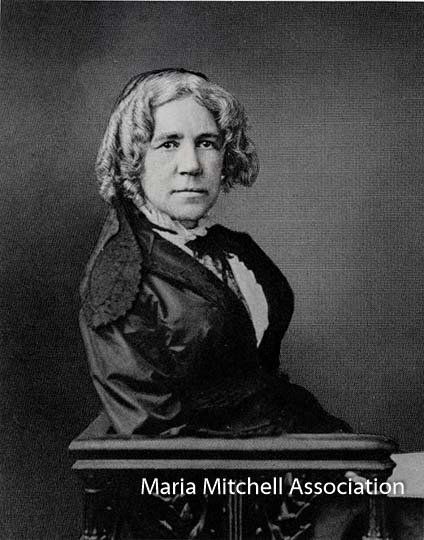
May 6, 1878 Between the clouds, Miss Spalding obtained 7 photographs of Mercury on the Sun. It is comfort to me to be able to plan and do a new kind of work. The large telescope worked better than usual, Clark having just been to the Observatory. Clark, as in Alvan Clark, a man who would become the premier telescope maker in America and who built Maria Mitchell’s 5-inch Alvan Clark refractor that she purchased from him (after working with him to build it per her specifications) with money gifted to her from “The Women of America” led by Elizabeth Peabody. More than likely, it is this telescope she is referring to as she did use it in the Vassar College Observatory with her students – and it is also taking center stage in photographs, along with her (first her father’s) Dolland telescope.  Maria had decided she would photograph the Sun on every clear day, and this was one of those results. She would use these images, with her students, to study sun spots and their changes. With her students, Maria would photograph the transit of Mercury as noted above. She would also photograph the transit of Venus a few years later with her students. JNLF
By Jascin N. Leonardo Finger April 27, 2026
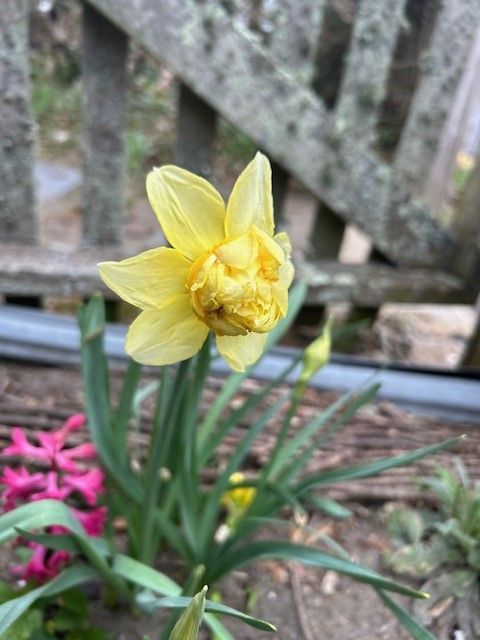
And with it, some of the heirloom daffodils I purchased for the Mitchell House last fall. A place was recommended to me by two longtime friends of the MMA and gardeners extraordinaire. It is called Old House Gardens. I ordered a small amount as we now have a plethora of voles on Vestal Street – I believe I complained about them here last year. They won’t eat daffodils so I got a few of “Butter and Eggs” (1777) and “Conspicuus” (1869) as either of these could have appeared in William Mitchell’s gardens. They were not listed in a letter from John Quincy Adams that I have mentioned before. But, Adams was not here visiting the Mitchell family when the daffodils would have been in bloom. The one pictured here is “Butter and Eggs” not completely unfurled. JNLF
By Jascin N. Leonardo Finger April 13, 2026
April 1878. The conference of Woman’s Congress officers met in Washington. Because we had one member in Washington we were invited to meet in that place. I went on at a great expense of time, money and strength . . . . We were in session at least nine hours. I think that more than half of that was used by Mrs. Spencer and Mrs. Sayles. The only motion which I carried through was to pay the Secretary $200 . . . In 1878, that was a long train(s) ride to Washington, DC from Poughkeepsie, NY and Vassar College. If Maria seems perturbed, I am sure she was. As president of the Association for the Advancement of Women, and thus the Congress, she had to be at the meeting. But it appears she did not get much say in the nine hour meeting. This was also a long trip to take when she had another, even longer trip coming up in July of 1878. In that month, she would travel with students and her sister, Phebe, out west to Colorado to view the eclipse and that train and wagon ride I am sure was weighing on her mind – not just the physical trip but making her way for an important eclipse viewing event. JNLF
Show More